/ Monthly Market Update - June 2026
Uranium: The Strategic Bottleneck in a Resurgent Nuclear Era
As governments and companies seek dependable, low‑carbon electricity, the availability of uranium is becoming a decisive factor, shaped by concentrated supply, geopolitics and long lead times.
Table of Contents
Insights
From ‘Uranium Interest’ to ‘Uranium Panic’
Over the past decade, nuclear energy sat in an ambiguous position within global energy policy and investment portfolios. While its low‑carbon credentials were acknowledged, lingering concerns over cost overruns, public acceptance, safety, and political support prevented nuclear from playing a central role in the energy transition narrative. That positioning has now changed decisively. A combination of structural forces has shifted nuclear from a theoretical solution to a practical necessity.
Three forces stand out. First, the erosion of energy security (following successive geopolitical shocks) has forced governments to re‑evaluate their reliance on imported fossil fuels. Second, decarbonisation goals have collided with the physical limits of renewable‑only systems, particularly the challenge of providing reliable baseload electricity at scale. Third, the rapid growth in electricity demand from artificial intelligence, data centres and industrial electrification has exposed the inadequacy of existing power infrastructure. Together, these forces have reframed nuclear not as an ideological choice, but as a functional one.
What is increasingly evident, however, is that the success of any nuclear revival depends less on reactor technologies themselves and more on the resilience of the upstream fuel cycle. At the centre of this equation lies uranium. Think of natural uranium as the crude oil of the nuclear world. It is the foundational input that underpins nuclear power generation and sits at the very first step of the fuel cycle.
As nuclear power transitions from renewed conviction to tangible construction, uranium is emerging as the critical bottleneck that will shape the pace, cost and investability of the nuclear renaissance.
Nuclear energy’s return to strategic relevance
Nuclear energy has regained strategic importance as governments across the US, Europe and Asia move beyond policy support to tangible actions such as regulatory reform, subsidies and fuel cycle backing. At the same time, demand dynamics are strengthening. Large technology companies have been emerging as key buyers willing to secure long-term power agreements, improving project economics and revenue visibility.
Markets have responded by favouring segments with near-term execution and cash flow, particularly existing nuclear utilities, engineering firms and uranium producers, highlighting a shift towards practical delivery where uranium’s role becomes increasingly critical.
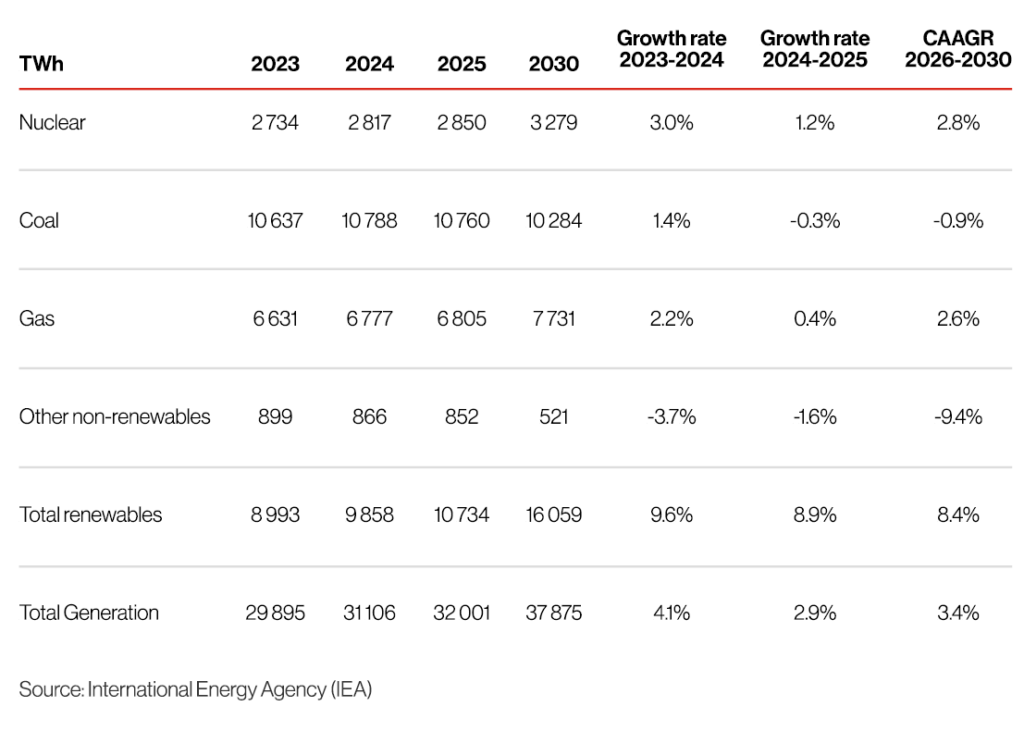
Figure 1: Breakdown of Global Electricity Supply, 2023-2030
Uranium as the foundation of the nuclear value chain
Uranium occupies a unique position within global energy markets. Unlike oil, gas or coal, uranium is not procured to meet immediate consumption needs, but to support infrastructure assets with operational lives measured in decades. Once a reactor is built, fuel demand becomes non-discretionary and structurally price inelastic.
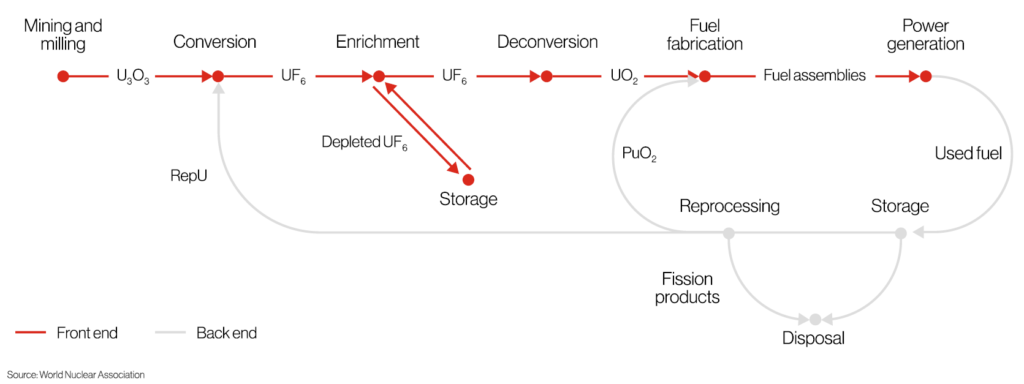
Uranium moves through a complete nuclear cycle starting with mining and milling into U₃O₈(uranium oxide, also known as Yellowcake), which is then converted into UF₆ gas for enrichment to increase the fissile U‑235 content. The enriched uranium is converted back into solid UO₂ and fabricated into fuel assemblies for use in nuclear reactors, where fission generates electricity and produces spent fuel containing remaining uranium, plutonium, and fission products. This spent fuel is either stored and eventually disposed of, or reprocessed to recover usable uranium and plutonium, which are recycled back into the fuel cycle, with only the final fission waste sent for disposal.
Figure 2: The stages of the nuclear fuel cycle
From an economic perspective, uranium fuel represents only a modest portion of the total cost of nuclear power generation. Unlike fossil fuels, nuclear is largely insulated from commodity price volatility, as uranium is procured through long-term contracts, supported by utility-held inventories, and accounts for only a small share of overall generation costs. As a result, even substantial increases in uranium prices have a limited impact on the levelized cost of electricity produced by a reactor. This structural insensitivity shifts operator behaviour towards prioritising long-term fuel security over marginal price optimisation—particularly in a context where nuclear generation plays a critical role in ensuring system reliability and national energy resilience.
Figure 3: LCOE in select regions in the IEA NZE by 2050 scenario
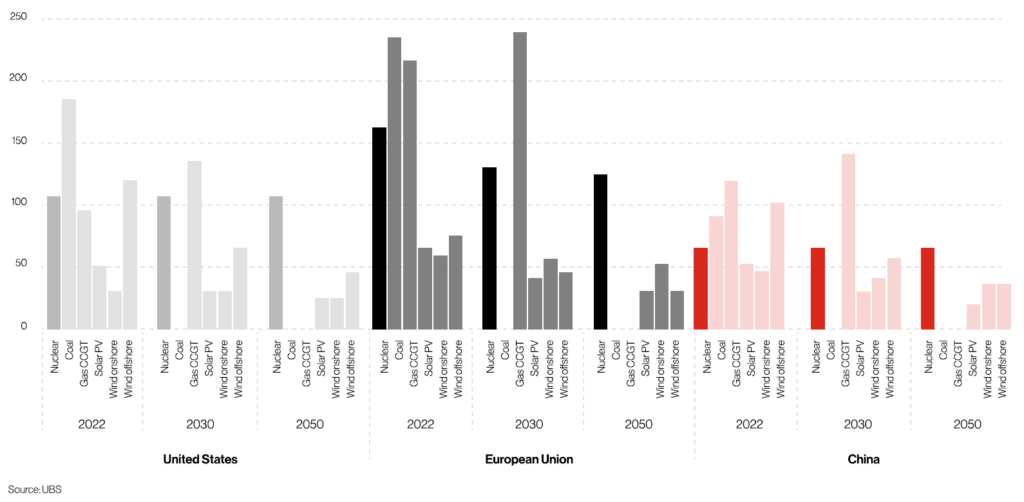
As illustrated in the figure 3, fossil fuel generation exhibits significant LCOE (Levelised Cost of Electricity) variability across regions and time, reflecting direct exposure to volatile fuel inputs such as gas. In contrast, nuclear costs remain comparatively stable, as the cost structure is dominated by upfront capital rather than ongoing commodity inputs.
Reliability in a Grid Built for Electrification
This dynamic transforms uranium from a conventional commodity into a strategic resource. Its availability does not merely influence price cycles but actively determines whether nuclear policy ambitions can be realised.
The energy transition has been defined by speed: solar and wind have cut emissions rapidly because they can be deployed quickly and scaled modularly. But grids are now facing a different problem—reliability under accelerating electricity demand. When the sun sets early or wind output swings, dispatchable low‑carbon power matters. This is where nuclear has re-entered strategic planning: it provides stable baseload generation and supports grid resilience as electrification expands across industry, transport and digital infrastructure.
This is not an ‘either/or’ debate. Renewables are the fast-moving edge of decarbonisation, while nuclear is increasingly treated as the long-duration backbone that keeps system reliability intact during periods of intermittency. The implication for uranium is straightforward: if nuclear capacity is preserved and expanded, uranium demand is not optional, it is structurally required.
With the highest capacity factor among all energy sources, nuclear plants operate more efficiently and with fewer interruptions. Designed for long operational cycles without frequent refuelling and requiring minimal maintenance, nuclear power ensures stable, long-term energy generation, making it a critical solution for powering global growth.
Decarbonisation and the need for clean baseload power
There is growing consensus that nuclear energy will be essential to any credible decarbonisation pathway to 2050. Policymakers are increasingly aligned with this view, reflected in commitments made at COP28, where nuclear was recognised as a key technology and more than thirty countries pledged to triple global nuclear capacity by mid‑century.
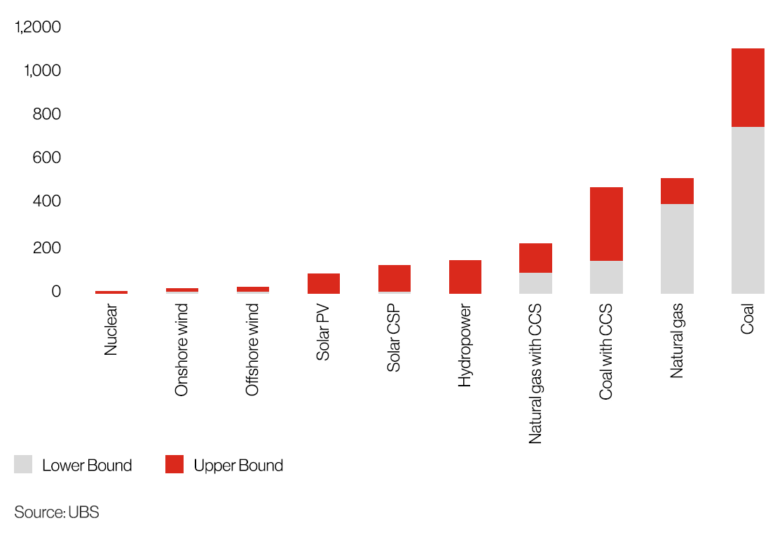
This reassessment has been reinforced by the need for carbon‑free baseload power, highlighted by the round‑the‑clock nature of AI‑driven electricity demand and the rising system costs associated with high penetration of intermittent renewables. Nuclear power is the lowest CO2 emitting source of power (Figure 4). Against this backdrop, life‑extension programmes for existing nuclear plants have gained traction as a pragmatic solution to address near‑term baseload constraints.
Figure 4: US life-cycle CO2 emissions by type
Rising power needs and long-term hyperscaler demand
The International Energy Agency (IEA) estimates that global electricity demand could double by 2050, with electricity consumption from data centres alone potentially reaching this level as early as 2030. Hyperscale technology companies are increasingly identifying power procurement as the primary constraint to further AI expansion, as existing grid infrastructure is unlikely to keep pace with the anticipated surge in demand.
As a result, many hyperscalers are turning to “behind-the-metre” power solutions—effectively adopting a bring‑your‑own‑power (BYOP) approach—to secure reliable energy supply. In this context, nuclear power’s unique attributes as a highly energy‑dense, firm baseload and emissions‑free source have positioned it as a critical component of the solution, particularly for companies with ambitious net‑zero commitments.
To date, this has largely taken the form of long‑term offtake agreements and power purchase agreements (PPAs), which provide pricing and revenue certainty for both nuclear developers and technology firms. Notable examples include Microsoft’s and Meta’s 20‑year PPAs with Constellation Energy to support the restart of Three Mile Island and the extension of the Clinton Clean Energy Center, as well as Google’s offtake agreement with Kairos Power to source electricity from small modular reactors expected to come online by 2035.
The emergence of long‑dated, price‑inelastic demand from technology companies represents a structurally supportive driver for the long‑term growth of the nuclear power sector.
These factors together underscore our conviction that we are the start of a nuclear supercycle.
China’s Nuclear Edge
However, translating this demand into reality depends critically on execution capacity. This is where regional divergence becomes most pronounced. Global nuclear capacity is shifting from North America (currently about 30% of the fleet) to Asia, which is set to overtake by 2030, driven largely by China’s dominance in reactor construction.
This shift is fuelling strategic US‑China competition, with the US responding by aggressively promoting nuclear expansion (targeting a quadrupling by 2050) through state-backed industrial policies, reflecting both energy security needs (especially for AI-driven demand) and a strategic pivot to counter China’s technological lead.
Figure 5: Current Nuclear Reactor Construction by Country
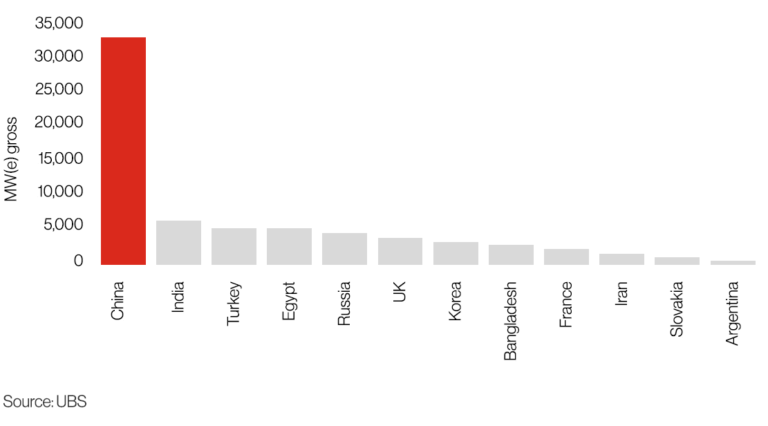
China’s lead in conventional reactor construction is rooted in scale and repetition. Asia accounts for about 60% of global nuclear capacity under construction, and China alone represents roughly half of capacity under construction, keeping its supply chain and project teams continuously active. Policy is translating into throughput: China approved 10 new reactors in April 2025, and approvals since 2021 have exceeded those of the entire 2011–2020 decade. This continuity drives a meaningful speed advantage — Japan, Korea and China historically completed new builds in roughly five to six years, as compared to flagship European projects such as Flamanville 3 and Olkiluoto 3 that took about 17 years, with materially higher $/kW outcomes.
Taken together, China’s continuous build pipeline, faster delivery timelines, and lower cost structure underscore a clear execution advantage, reinforcing its position as the marginal driver of global nuclear capacity expansion.
Crucially, this execution advantage translates directly into uranium demand visibility, as China becomes a reliable source of incremental reactor-driven fuel consumption.
Gold’s appeal lies in its neutrality. It is no one’s liability, cannot be frozen by a foreign authority, and sits outside payment systems. For emerging market reserve managers, it provides insurance against both financial and political risk. The resurgence of gold is not a nostalgia trade; it is a rational response to a more contested international order.
Structural fragility on the supply side
Despite uranium’s abundance in geological terms, the supply side of the market exhibits profound structural constraints. Production is geographically concentrated, mining investment is slow to respond to price signals, and the broader fuel cycle comprises multiple regulated and capital‑intensive steps beyond extraction.
A significant portion of global uranium production originates from a small number of jurisdictions, some of which are politically sensitive or embedded within fragile logistics networks. This concentration creates systemic vulnerability, where disruptions due to geopolitics, transport constraints or policy shifts can have disproportionate effects on global supply.
Compounding this issue are the long lead times associated with uranium mining. From initial discovery to commercial production, new projects can take a decade or more to progress, constrained by permitting, environmental approvals and financing requirements. The prolonged bear market that followed the Fukushima incident further depressed investment across the sector, resulting in mine closures, deferred exploration and a shrinking development pipeline.
Beyond mining, the real bottleneck lies in conversion and enrichment — highly regulated, capital-intensive segments dominated by a small number of state-linked entities. Advanced reactor designs and small modular reactors add another layer of complexity by requiring higher‑assay fuels that are currently produced at very limited scale.
The uranium market is tightening and is set to be structurally undersupplied in the early 2030s. Demand is set to more than double by 2040, drive first by the emergence of small modular reactors (SMRs) in the early 2030s.
Figure 6: Access to uranium is a key bottleneck for nuclear build out, given the geographical concentration in production
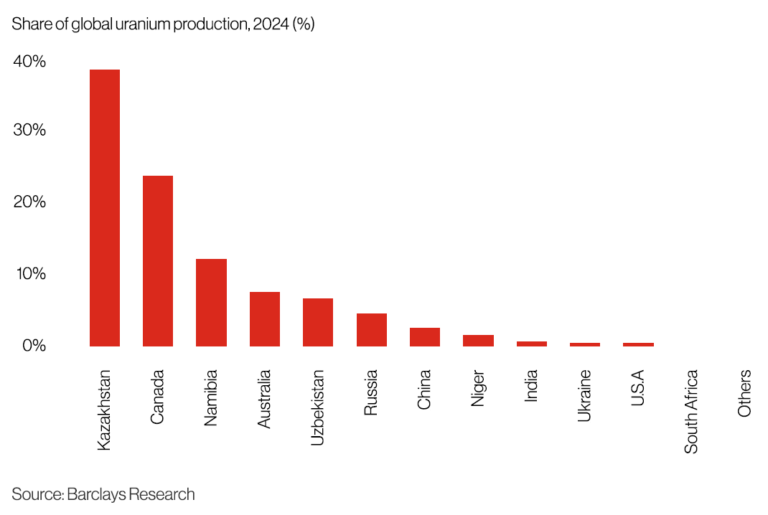
Disruptions need not come from mining interruptions alone; bottlenecks in conversion, enrichment availability, transport restrictions, or sanction regimes can all tighten effective supply. This is why the market is increasingly sensitive to policy signals and geopolitical realignment.
Only a limited number of jurisdictions dominate the midstream steps of the fuel cycle. This creates strategic dependencies that resemble, on a smaller scale, the way pipeline networks and LNG infrastructure shape gas markets. As a result, uranium is increasingly priced with a geopolitical premium, especially when policy shifts or sanctions raise uncertainty around access to fuel services.
In addition, sulfuric acid is a critical input in uranium extraction, particularly for in‑situ recovery, making it a potential bottleneck as supply depends on external factors beyond the uranium market. Demand is tightly linked to competing industrial uses such as copper processing, while supply is constrained by its dependence on sulphur (a by‑product of oil and gas refining) creating exposure to energy markets and geopolitical risks.
With the Persian Gulf accounting for roughly half of global sulphur trade and China acting as a key producer and exporter, any disruptions, export restrictions, or supply tightness can limit acid availability, thereby constraining uranium production growth despite strong underlying demand.
The cumulative effect of these factors is a supply system that lacks flexibility precisely as demand visibility improves. While short‑term supply remains sufficient, forward‑looking balances suggest increasing tightness as nuclear build‑out accelerates into the next decade.
Geopolitics and the re pricing of energy security
In recent years, uranium has been drawn directly into the sphere of geopolitics. The broader re‑assessment of strategic dependencies following energy and security crises has prompted governments to treat nuclear fuel as a matter of national interest rather than pure market economics.
Many advanced economies are highly exposed to external uranium supply chains while holding limited strategic inventories. This asymmetry has become increasingly uncomfortable as geopolitical tensions intensify, and trade restrictions proliferate across critical materials. Uranium now exhibits dynamics like those seen in rare earths and battery metals, where access, not just price, determines strategic outcomes.
Policy responses have begun to reflect this reality. Governments are supporting domestic production, incentivising fuel‑cycle investment and encouraging long‑term contracting to rebuild supply resilience. In several jurisdictions, uranium mining has been reclassified as a strategic or concessional activity, signalling a lasting shift in how the material is perceived.
In the US, nuclear policy has accelerated, led by a US$2.7bn Department of Energy package to expand domestic enrichment capacity (across LEU and HALEU), alongside regulatory reforms, aimed at easing upstream fuel bottlenecks and enabling advanced reactor deployment.
In Asia, reliance on imported hydrocarbons—particularly via the Strait of Hormuz—has made geopolitical tensions a key catalyst for stronger nuclear adoption, while in Europe, rising energy costs and deteriorating trade terms have reinforced the case for nuclear as a reliable domestic energy source, supported by improving public sentiment and growing policy backing.
In Japan, as outlined in its 7th Strategic Energy Plan, the country aims to ‘’maximize’’ nuclear energy to achieve carbon neutrality by 2050. Currently, Japan has 15 operable nuclear reactors, providing a combined capacity of about 33GW. To sustain the nuclear fleet, the parliament approved rules allowing reactors to operate beyond 60 years.
For investors, this shift alters the nature of uranium exposure. Pricing is no longer driven solely by marginal cost curves but increasingly influenced by policy support, strategic stockpiling and security‑driven procurement. This environment favours producers with assets aligned to jurisdictions actively reshoring their energy value chains.
Conclusion: Uranium as the strategic fulcrum of the nuclear renaissance
The global nuclear revival is no longer defined by debate over relevance but by questions of delivery. In answering those questions, uranium emerges as the linchpin of the system. It is the least substitutable input, the most constrained segment of the value chain, and increasingly the focus of strategic policy intervention.
As nuclear power re‑establishes itself as a cornerstone of clean, reliable electricity supply, uranium transitions from a peripheral commodity to a foundational asset. For investors, this transformation reshapes the opportunity set. Exposure to uranium is not merely exposure to fuel demand growth, but to the broader themes of energy security, electrification and industrial sovereignty.
In that sense, uranium represents one of the clearest long‑term expressions of the new nuclear economics — an economics defined less by theoretical capacity targets and more by the practical realities of building, fuelling and sustaining the next generation of global power infrastructure.
Disclaimer
This material is for the use of the recipient in accordance with the restrictions and/or limitations implemented by any applicable laws and regulations only. It is intended only for the recipient and may not be published, circulated, reproduced or distributed in whole or in part to any other person without the Bank’s prior written consent. Unless otherwise indicated, the information is made available for informational purposes only, without considering the recipient’s financial situation, investment objectives, risk tolerance, financial situation, or any other particular needs and should not be treated as legal or taxation advice.
The information is not and should not be construed as an offer or a solicitation to deal in any investment product or to enter into any legal relations. Any investment decision made based on the information provided is the sole responsibility of the client. The Bank disclaims any liability for any losses or damages resulting from the use of this information. The Bank assumes no responsibility for the way in which the client may choose to use or apply this information, or for any investment decision or transaction that the client might undertake as a consequence. It is the client’s own responsibility to ensure that this product is suitable for him or her and the client must make his or her own decision concerning this product. The client may also wish to obtain advice from other sources before making any decision.
Past performance is not indicative of future results. Any forecast on the economy, stock market, bond market and economic trends of the markets are not necessarily indicative of the future or likely performance of the product. Any investment involves risks, including the total loss of the invested capital.
For queries arising from, or in connection with this material, please contact the person who sent you this material. This advertisement has not been reviewed by the Monetary Authority of Singapore.