/ Monthly Market Update - August 2026
How thirsty is the AI Industry?
As AI becomes the defining infrastructure of the digital economy, its demand for computing power is revealing a less visible but increasingly critical dependency: water.
Table of Contents
Insights
Artificial intelligence (AI) has become a defining technology of the Fourth Industrial Revolution, moving societies beyond digitization toward the optimization and automation of complex systems. AI systems that learn, perceive, reason, and generate content are now embedded across economies and daily lives, supporting services from translation to finance, healthcare, energy management, and transportation.
The pace of adoption has been extraordinary, with market projections anticipating that AI will become a trillion-dollar scale industry within the next decade.
When a technology scales this quickly, unintended social, economic, geopolitical, and environmental consequences can accumulate quietly and then become complex to correct once systems, investments, and dependencies lock in.
Public debate has rightly focused on AI’s most visible risks, such as bias, privacy, disinformation, labor disruption, and inequality. Yet one of AI’s most consequential dimensions remains comparatively underexamined: its environmental footprint. AI is not “just code”; it also involves physical infrastructure and supply chains, including data centers, semiconductors, electricity generation, cooling systems, water withdrawals, land use, critical minerals, and, eventually, e-waste.
A critical dimension is water: AI infrastructure consumes freshwater through evaporative cooling, indirect water use in electricity generation, and water-intensive semiconductor manufacturing.
AI’s water footprint has three interconnected components: (1) indirect water use at power-generation facilities supplying electricity to data centers; (2) direct on-site water consumption by data centers for evaporative cooling and humidification systems; and (3) embedded water use in semiconductor manufacturing, where chip fabrication processes consume thousands of liters per wafer.
In this piece, we focus on the latter two components of AI’s water footprint: direct water consumption by data centers and embedded water use in semiconductor manufacturing.
Figure 1 – AI’s water footprint
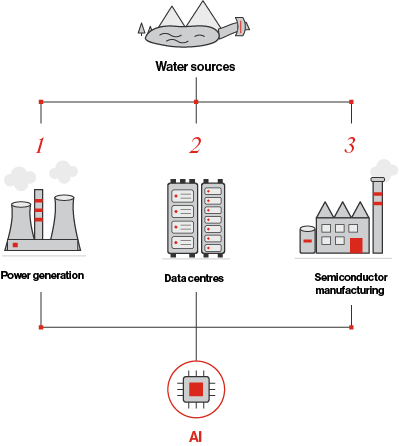
A number of factors determine overall water intensity, and this changes the relative water use in semiconductor manufacturing. In this paper, we will not discuss the indirect water consumption related to energy supply of data centres.
For clarity of concept, water withdrawals refer to the total volume of water drawn from surface water and groundwater sources to meet the needs of households, agriculture, industry and energy production. Such withdrawals are a normal and essential part of economic activity and societal development. However, growing withdrawals can place increasing pressure on water resources, particularly in regions where replenishment rates are limited or water scarcity is already a concern.
Recent estimates suggest that accelerated AI adoption alone could result in an additional 4.2 to 6.6 billion cubic meters of annual water withdrawal by 2027, including onsite cooling and offsite electricity generation. This projection is equivalent to four to six times the annual water withdrawal of Denmark, driven by data-center demand alone. This underscores the need for urgent action.
Data centers - Thirsty for water
How much water is required to train an LLM like ChatGPT3? This consumption is substantial: 2024 analysis estimated that training GPT-3 required approximately 700,000 liters of clean freshwater, the same amount of water required to produce 370 BMW vehicles.
Water plays a critical role in keeping infrastructure online. Servers and networking devices run constantly and generate enormous amounts of heat. Without effective heat dissipation, they overheat and fail.
While air-based systems are widely used, water-based cooling is often far more efficient at managing the massive thermal loads produced by modern, high-density hardware, especially for AI and other intensive workloads.
Based on estimates of the current breakdown of cooling technologies, a 100 MW hyperscale data center in the United States consumes around 2 million liters per day on average, equivalent to about 6,500 households.
The result is a substantial and continuous strain on local water resources, often drawn from municipal potable systems because they are the most accessible. In water-stressed regions, this can put data centers in direct competition with communities, agriculture, and other industries for the same limited supplies.
At a global level, data-center water consumption is currently around 560 billion liters per year and could rise to around 1,200 billion liters per year by 2030. Global water withdrawals for data centers are expected to show a similarly steep increase over the same period.
Several trends are likely to shape the water profile of data centers by 2030.
1. Water demand will grow sharply with AI infrastructure expansion
Data centers are inherently water-intensive due to cooling needs, especially for facilities hosting AI training and inference workloads.
This trend means water demand across the sector could intensify by 2030 and beyond, driven by both new builds and increased compute density per facility.
2. Water availability and climate will influence siting decisions
Water supply and regulatory frameworks are already emerging as location determinants for new data-center projects. In some countries, such as the United States, withdrawals for data centers today equate to less than 10% of annual municipal water withdrawals, but elsewhere, the water demands of data centers could compete with water for agricultural irrigation and municipal uses and even affect the supply chains that underpin microchip manufacturing.
Climate also matters. In a warm and humid climate, cooling becomes more water-intensive. For instance, Microsoft estimated that Water Usage Effectiveness (WUE) for direct cooling in Asia Pacific was more than three times the global average for its data centers.
Operators are responding by factoring water security and sustainability into early site assessments and by prioritizing sources that reduce freshwater withdrawal.
Key implications of such competition include:
- Governments and utilities are increasingly scrutinizing water permits and allocations for high-consumption facilities. For example, in Europe, the Climate Neutral Data Centre Pact, signed by 97 operators and associations, targets a WUE reduction to less than 0.4 liters per kWh by 2040.
- Companies facing higher compliance risk in basins with tight supply or during drought periods.
- Some municipalities considering moratoriums or regulatory caps on the construction of new data centers until water strategies are formalized. The New York state legislature passed such bill recently, imposing a one-year pause on permits for new data centers with peak demand of 20 MW or more.
3. Recycling and alternative water strategies are becoming essential
Water reuse, closed-loop cooling, and advanced treatment technologies are no longer optional add-ons; they are becoming baseline requirements for long-term viability. Several industry leaders are investing in water-efficient system designs that recirculate or reuse cooling water, significantly lowering net consumption.
Circular and recycled water strategies not only reduce dependency on local freshwater but also cushion data centers against regulatory and community pushback in stressed basins.
Semiconductor industry - the vital challenge of water sustainability
In semiconductor manufacturing, the fabrication process of silicon semiconductor devices usually consists of six universal steps: oxidation, lithography, etching, doping, chemical vapor deposition, and metallization. These stages are crucial for shaping silicon wafers and creating the intricate circuitry that forms the basis of semiconductor devices.
Half of these manufacturing processes require ultra-pure water usage to maintain the integrity and quality of the semiconductor devices.
During the oxidation step, ultra-pure water is utilized for cleaning and rinsing purposes, to ensure the purity of the oxide layer formed on the surface of silicon wafers.
In the lithography stage, ultra-pure water plays a critical role in cleaning and rinsing the wafers after each exposure to remove any residual photoresist or contaminants, thereby preserving accuracy and precision.
Finally, in the chemical vapor deposition process, ultra-pure water serves as a solvent and rinsing agent to prepare solutions and clean the deposition chamber, facilitating the deposition of thin films onto silicon wafers with purity and reliability.
Consequently, at the manufacturing stage, almost 90% of water consumption is associated with ultra-pure water production.
The numbers related to semiconductor manufacturing water usage are staggering:
- In semiconductor fabrication facilities, about three-quarters of the total water used is directly related to the manufacturing process.
- Generating 1,000 gallons* of ultra-pure water consumes approximately 1,400 to 1,600 gallons of municipal water. (* 1 gallon is equivalent to 3.78 liters).
- A large semiconductor fabrication facility processing around 40,000 wafers monthly could consume up to 18 million liters of water daily. This is equivalent to the annual water consumption of a city inhabited by 60,000 people.
Water consumption from chip manufacturing for data centers could grow more than 50% from 2023 levels to around 70 billion liters in 2030, faster than new servers are added to data centers, driven by an increasing number of accelerated servers, which tend to contain more chips than conventional servers.

The associated risks for both data centers and semiconductor manufacturers
The rapid expansion of both data centers and the semiconductor industry presents a significant challenge in terms of sustainable water management. The risks associated with unsustainable water usage are multifaceted, with significant implications for both the industry and the environment, including:
- Environmental Impact and Sustainability: Unsustainable water usage can lead to the depletion of local water sources and ecosystems, impacting aquatic habitats, biodiversity, and water quality. Discharging untreated or inadequately treated wastewater into water bodies can also contribute to pollution, harming aquatic life and ecosystems.
- Regulatory Compliance: Regulatory bodies impose strict standards and regulations on water usage and wastewater discharge, both in terms of quality and quantity, to protect water resources and public health. Non-compliance with these regulations can result in legal consequences, fines, and reputational damage for companies, affecting their operations and bottom line.
- Water Scarcity: In regions experiencing water scarcity or drought conditions, competition for water resources can intensify, leading to conflicts with local communities, agriculture, and other industries. Poor management of this risk could affect operations and creditworthiness. In Taipei, for example, semiconductor manufacturers were subject to water restrictions during a drought in 2021, requiring water-reduction strategies to be implemented.
- POTW (Publicly Owned Treatment Works) infrastructure limitations: These limitations restrict both raw water supply into fabrication facilities and effluent removal after manufacturing. This can constrain production capacity and efficiency, while inadequate wastewater transport may undermine environmental compliance and create regulatory risks.
- Financial Costs: Unsustainable water usage practices can incur significant financial costs, including expenses related to water procurement, treatment, and disposal.
- Reputation and Stakeholder Relations: Negative publicity surrounding water-related issues, such as pollution incidents or water scarcity concerns, can damage a company’s reputation and erode stakeholder trust.
New technology to save water - a deep dive into techniques by data centres
The opportunity lies in circular water management strategies, which can deliver up to 75% water savings. Solutions can range from:
- water optimization, such as advanced liquid and closed-loop cooling solutions in data centers; and
- replenishment, offering the potential to address water scarcity and energy efficiency challenges.
Water optimization focuses on minimizing the actual water usage of data centers through smart water management systems that continuously monitor and adjust water usage, alongside innovative and less water-intensive cooling methods.
Traditional evaporative cooling systems – which lose water through evaporation as part of heat rejection – are under scrutiny both for water use and environmental impact. New approaches emerging in the industry include:
- Hybrid or dry cooling techniques that significantly lower water use.
- Closed-loop systems that minimize external withdrawals.
- More granular water performance metrics, such as WUE, that help benchmark and manage water performance at scale.
First, smart water management systems are built on real-time sensors that track and adjust consumption according to cooling demand. This proactive approach enables predictive modeling and a precise understanding of water needs, achieving up to 25% less water consumption by optimizing algorithms that preempt and adjust water-based cooling.
AI could also help address water stress risks in the economy as a whole via predictive analytics for leak detection, smart irrigation, and the optimization of water infrastructure. Moreover, AI has applications in desalination technologies, which could help expand the supply of usable water for cooling in coastal regions.
With these systems in place, data centers are well positioned to implement advanced liquid and closed-loop cooling solutions, such as liquid immersion and direct-to-chip cooling.
Secondly, liquid immersion cooling involves submerging electronic components, such as servers or central processing units (CPUs), in a non-conductive liquid that efficiently absorbs their heat and transfers it to a heat exchanger.
Compared to traditional methods, this can reduce water consumption by up to 91%, energy consumption by 50% and space occupancy by 85% when compared to conventional air-cooling methods.
Finally, one of the latest innovations is direct-to-chip cooling, targeting processors at the source. By circulating dielectric coolant across the processor’s cold plate, it absorbs heat directly, maintaining optimal processor temperature, thereby minimizing overheating and excessive water consumption in the cooling process.
This innovation can reduce water consumption by 20-90% in water-scarce regions and decrease facility power needs by 18%, depending on the technology and climate. The water-savings potential varies by system design, with server-level cooling offering greater benefits than facility-level approaches.
With Microsoft already deploying closed-loop liquid cooling, Carrier investing in direct-to-chip cooling technology, and Ecolab’s recent launch of a cooling monitoring solution for direct-to-chip cooling, momentum behind advanced liquid cooling solutions is clearly accelerating.
Beyond their four walls, data centers can also play a key role in replenishing water in regions where they operate. While water optimization reduces consumption, water replenishment focuses on restoring water sources by enhancing water availability and quality, helping ensure that local communities have access to clean water.
Key strategies include wastewater treatment and reuse, ideally within the same watershed as withdrawal, for irrigation and industrial processes, recharging groundwater reservoirs, and conserving water through efficient irrigation practices, among many others.
Orange County, California, is a leading example of a community that recycles wastewater to produce 490 million liters of drinking water daily, enough for approximately 1 million residents. Major cloud providers are also advancing water-positive initiatives, such as Microsoft and AWS (Amazon Web Services) investing in water replenishment in water-stressed regions.
Case Study: How Google Is Scaling Water Replenishment Alongside Data-Center Growth
As a case study, Google has pledged to be “water positive” by 2030, by combining recycling and replenishment programs with reductions in the direct WUE of their operations.
Google also announced in June 2026 that it was investing $17 million into water stewardship projects across seven states, according to a company blog. Some of these projects include partnering with local utilities to fund infrastructure improvements. For example, in Omaha, Nebraska, an undisclosed amount of funding will go towards a water line leak detection program at the Metropolitan Utilities District.
The company is reviewing more than 700 projects submitted through a request for information for replenishment projects, from which it will identify early-concept projects that are eligible for co-funding and can come online before 2030.
Google’s commitment to become “water positive” by the end of the decade puts it on par with competitors and fellow hyperscalers like Meta and Microsoft who each have their own goals of replenishing more water than they consume by 2030.
U.S. data centers directly consumed 66 billion liters of water in 2023, and hyperscale data centers are expected to use between 60 and 124 billion liters of water through direct consumption by 2028, according to a 2024 report from the University of California Berkeley Lab.
“Data centers are the nerve centers of the digital world … As we grow our data center footprint to support these services, we recognize that how we build is just as important as what we build,” Google Vice President of Global Infrastructure Bikash Koley and Head of Infrastructure Strategy and Sustainability Ben Townsend wrote on the June 3rd, 2026 on the Google blog.
In addition to setting water replenishment goals, Google also committed to help local water utilities modernize their infrastructure, report the company’s annual water consumption and use alternative and reclaimed water options for cooling where possible. The tech company currently has 165 water stewardship projects based in 97 different watersheds.
“Water is a critical component of data center development and operations,” Koley and Townsend wrote. “Our goal is to minimize our local impacts so that our growth does not come at the expense of the communities we call home.”
Google reported replenishing over 26 billion liters of water in 2025 and expects to replenish over 72 billion liters of water by 2030 through the implementation of all of its stewardship projects.

Semiconductors - The Path to Resilience with Sustainable Water Management
Semiconductor manufacturing facilities are also making headway. Addressing the water conundrum requires semiconductor companies to adopt sustainable water management practices, mainly recovering as much water as possible within their processes. This is where industrial water treatment comes to play.
Adopting sustainable water management practices offers significant cost savings and efficiency improvements for semiconductor companies, known for their high water usage. By implementing more efficient water recycling systems, these companies can drastically reduce the volume of freshwater required and lower their water procurement costs.
Advanced treatment technologies allow for the reuse of wastewater, reducing disposal and compliance costs. Efficient water management in semiconductor manufacturing also correlates with reduced energy consumption, as less energy is needed for heating, cooling, and transporting water, directly lowering operational costs.
By focusing on sustainable water management, semiconductor companies not only address the ethical aspects of resource conservation but also significantly enhance their operational efficiency and cost-effectiveness. This strategic focus ultimately contributes to a more resilient and financially stable business model.
Case Study: TSMC's Water-Positive Approach to Semiconductor Manufacturing
It cannot be overstated how important water is to semiconductor wafer fabrication factories. Taiwan Semiconductor Manufacturing Company (TSMC) has set a goal of becoming “water positive” by 2030, meaning that the company will replenish more water than it consumes. Striving to maximize the efficient use of every drop, it is aiming to create a win-win for both technology and the environment.
According to TSMC, the water used in its advanced manufacturing processes cannot exceed one milliliter of impurities in the equivalent of 1,000 Olympic-sized swimming pools of water. Using reclaimed water for advanced semiconductor processes, therefore, poses huge technical challenges.
Since 2015, TSMC had been running simulations on how to best make use of reclaimed wastewater on its production lines. In 2022, TSMC’s dedicated water reclamation plant in the Southern Taiwan Science Park (STSP) officially began operations, marking the first example of the use of reclaimed industrial water in advanced semiconductor manufacturing.
To ensure high chip yield rates, TSMC employs nearly 1,000 personnel at each plant to conduct strict quality-control measures. Starting with its mature process fabs, the company introduced reclaimed water into its five-nanometer and three-nanometer advanced processes in 2024. It was a major milestone of green innovation for the industry.
TSMC’s STSP facility, together with government-managed water reclamation plants in Tainan’s Yongkang and Anping districts, can supply approximately 67,000 cubic meters of water daily to the company’s STSP fabs. To date, TSMC’s Tainan-based fabs have used 19.65 million cubic meters of reclaimed water, cutting their reliance on city water by 31%.
Furthermore, TSMC and the Tainan City Government have pioneered the use in Taiwan of a “reclaimed water credits” mechanism, whereby reclaimed water is supplied to enterprises close to water reclamation plants in exchange for TSMC paying a premium on water from the regular supply, a premium which is acceptable against a larger flexibility in water sources. This enables flexible allocation of water supply within the region while reducing the carbon footprint of water distribution.
During the severe drought in Southern Taiwan in 2023, TSMC maintained stable operations by drawing from diverse water sources. Balancing the need for industrial competitiveness with the public’s right to water, the approach proved to be a win-win for TSMC and the region.
TSMC is now bringing this water-management experience in technological innovation to other manufacturing facilities worldwide. By partnering with local governments, communities, and academic institutions, TSMC has been implementing site-specific water management plans overseas.
In Kumamoto, Japan, its joint-venture subsidiary JASM applies various groundwater restoration strategies, including the flooding of paddy fields. By 2024, replenished water volume there had exceeded the amount of water consumed at the facility by more than three times. Meanwhile, at its production base in Arizona, USA, a water reclamation plant project has been initiated to strengthen the fab’s operational resilience under arid climatic conditions.
What this means for investors
From an investment perspective, AI is often viewed first through hyperscalers and then through the broader supply chain that enables their growth, including data centers, semiconductors, and hardware providers.
If we think a bit more upstream, we usually think of power generation sectors such as utility companies or electricity producers. In this piece, we uncovered another sector that participates in that supply chain but is often overlooked: the sector providing a key strategic natural resource to the AI industry-water.
When we look at water as part of the broader AI supply chain, investors can clearly see the risks posed to businesses and societies. Keeping these in mind, investors can look at companies that help address water concerns through water-cooling systems, water treatment technologies, water desalination processes, and smart water management solutions such as leak detection systems.
Conclusion: Water's role in the next phase of AI
The AI industry is still defining how water, energy and computing capacity can scale together. But one thing is already clear: water is no longer viewed in isolation. For data-center operators and semiconductor manufacturers, it is becoming part of what it means to grow sustainably, shaped by local communities, natural resource availability, regulation and competing users such as agriculture.
This matters because water stress is no longer a distant sustainability concern. Back in 2023, the World Resources Institute had already found that over half of the global population lives under highly water-stressed conditions for at least one month each year. WRI estimates that nearly one-third of global gross domestic product, or $70 trillion, will be exposed to high water stress by 2050.
For investors, the implication is not simply that AI needs more water. It is that the next phase of AI will require better water stewardship. Water is a strategic resource. We must manage it accordingly.
Disclaimer
This material is for the use of the recipient in accordance with the restrictions and/or limitations implemented by any applicable laws and regulations only. It is intended only for the recipient and may not be published, circulated, reproduced or distributed in whole or in part to any other person without the Bank’s prior written consent. Unless otherwise indicated, the information is made available for informational purposes only, without considering the recipient’s financial situation, investment objectives, risk tolerance, financial situation, or any other particular needs and should not be treated as legal or taxation advice.
The information is not and should not be construed as an offer or a solicitation to deal in any investment product or to enter into any legal relations. Any investment decision made based on the information provided is the sole responsibility of the client. The Bank disclaims any liability for any losses or damages resulting from the use of this information. The Bank assumes no responsibility for the way in which the client may choose to use or apply this information, or for any investment decision or transaction that the client might undertake as a consequence. It is the client’s own responsibility to ensure that this product is suitable for him or her and the client must make his or her own decision concerning this product. The client may also wish to obtain advice from other sources before making any decision.
Past performance is not indicative of future results. Any forecast on the economy, stock market, bond market and economic trends of the markets are not necessarily indicative of the future or likely performance of the product. Any investment involves risks, including the total loss of the invested capital.
For queries arising from, or in connection with this material, please contact the person who sent you this material. This advertisement has not been reviewed by the Monetary Authority of Singapore.