/ Monthly Market Update - October 2026
Beyond The Robot
Humanoid robotics extends beyond robot makers. Exame Physical AI, compute, actuators, sensors and supply-chain risks across the emerging ecosystem.
Table of Contents
Insights
Humanoid robots are the next frontier of Physical AI, extending intelligence beyond software and into the real world. Their potential is enormous. Unlike purpose-built machines, humanoids can work in environments already designed for people.
Yet the industry remains in its infancy. Most robots showcased today are still heavily scripted, remotely assisted, or confined to narrow industrial tasks. Widespread economic adoption is likely a story for the mid-2030s rather than the end of the decade. Even so, the market could expand from just $2-3 billion today to more than $200billion by 2035.
Humanoids are a powerful new growth engine for industrial companies that largely missed AI’s software-led first wave. They are as much an AI infrastructure story as they are a robotics story. Before robots can be deployed at scale, developers must build and train them. That creates demand for AI compute, accelerators, memory, networking, storage, simulation software, and edge processors.
Value creation will be spread across the entire ecosystem, extending far beyond robot manufacturers. In other words, we do not need to wait for humanoids to arrive in every factory and household. The monetization of the enabling technologies has already begun.
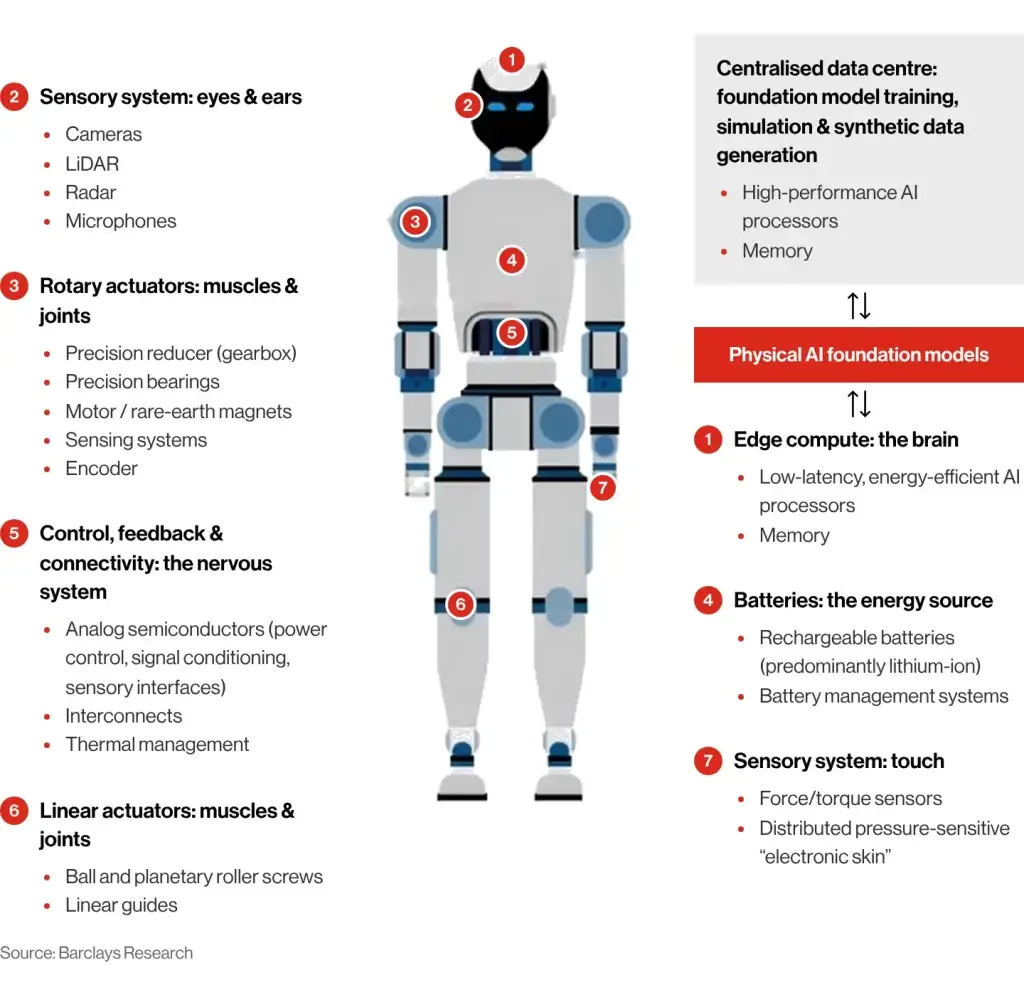
To understand where value will accrue, this report looks beneath the surface of the humanoid industry, tracing the network of technologies, critical components and supply chain dependencies that enable deployment at scale.
Figure 1 – Anatomy of a humanoid: from compute to components
Why humanoids matter, but why timing matters more
The strategic appeal of humanoids comes from labour scarcity and flexibility. Three demographic shifts are reshaping the global economy.
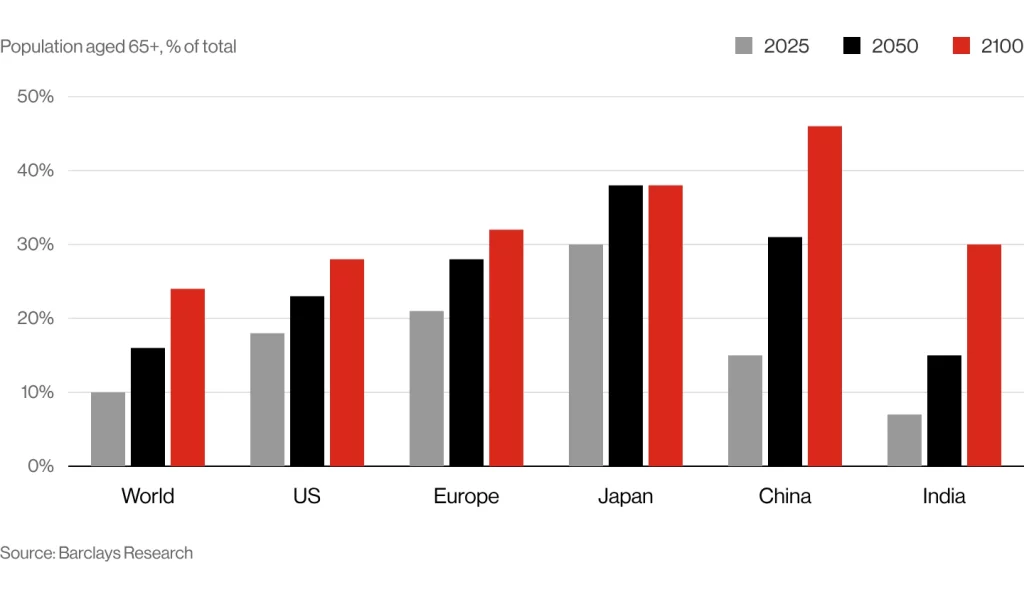
First, ageing population is creating headwinds as the share of people aged 65 and above rises from 10% today to 16% by 2050, while working-age cohorts stagnate.
Figure 2 – The share of people aged 65 and over is set to keep rising across major economies
Second, urbanization is accelerating, with nearly 70% of the world projected to live in cities by midcentury, concentrating talent in urban hubs and leaving sectors like manufacturing, agriculture, and elder care in rural areas short of labor.
Third, job preferences are changing, not always due to pay, but because they are repetitive and monotonous, physically demanding, hazardous, or simply less appealing than other opportunities.
The result is a growing mismatch between economic demand and workforce supply in critical sectors such as manufacturing and logistics, agriculture, and healthcare. Unlike traditional industrial robots, humanoids are designed to work inside human-centric environments without requiring facility redesign. This gives them flexibility that fixed automation, collaborative robots and autonomous mobile robots cannot fully replicate.
The investment challenge is that flexible automation is also harder to execute. Traditional industrial robots succeed because tasks are controlled, repeatable and engineered. Humanoids must perceive, reason and act in dynamic environments with safety, balance, manipulation and reliability constraints. This is why the intelligence stack is the current bottleneck. The industry still lacks a breakthrough AI model that can continuously improve from growing volumes of real-world data, enabling robots to perform reliably across diverse tasks and environments.
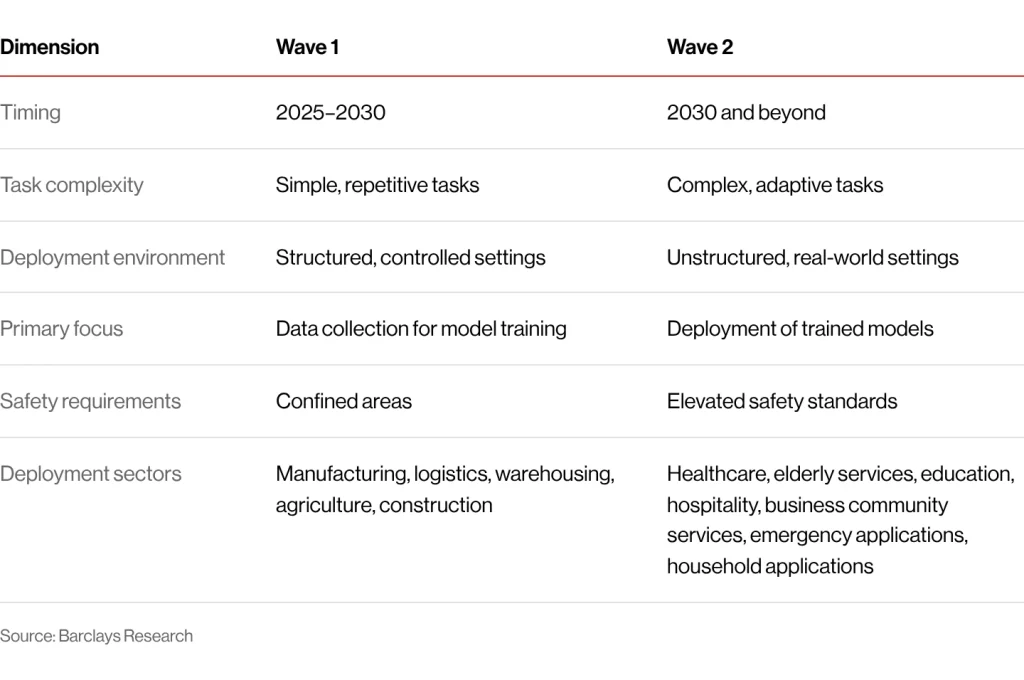
Near-term deployment should therefore concentrate in controlled industrial environments where the value proposition is clearest: automotive plants, warehouses, logistics, machine tending, tote handling, inspection, and repetitive light-manufacturing tasks. Broader home or consumer adoption is further away because open-ended household tasks require higher autonomy, better dexterity, lower failure rates and stronger safety frameworks.
Figure 3 – Two waves of humanoid deployment
Brains, Brawn, Batteries
The three Bs, namely brains, brawn and batteries, form the core pillars of the global humanoid robotics supply chain and represent the most compelling investment opportunity in the sector.
Figure 4: The three Bs of the humanoid robot architecture
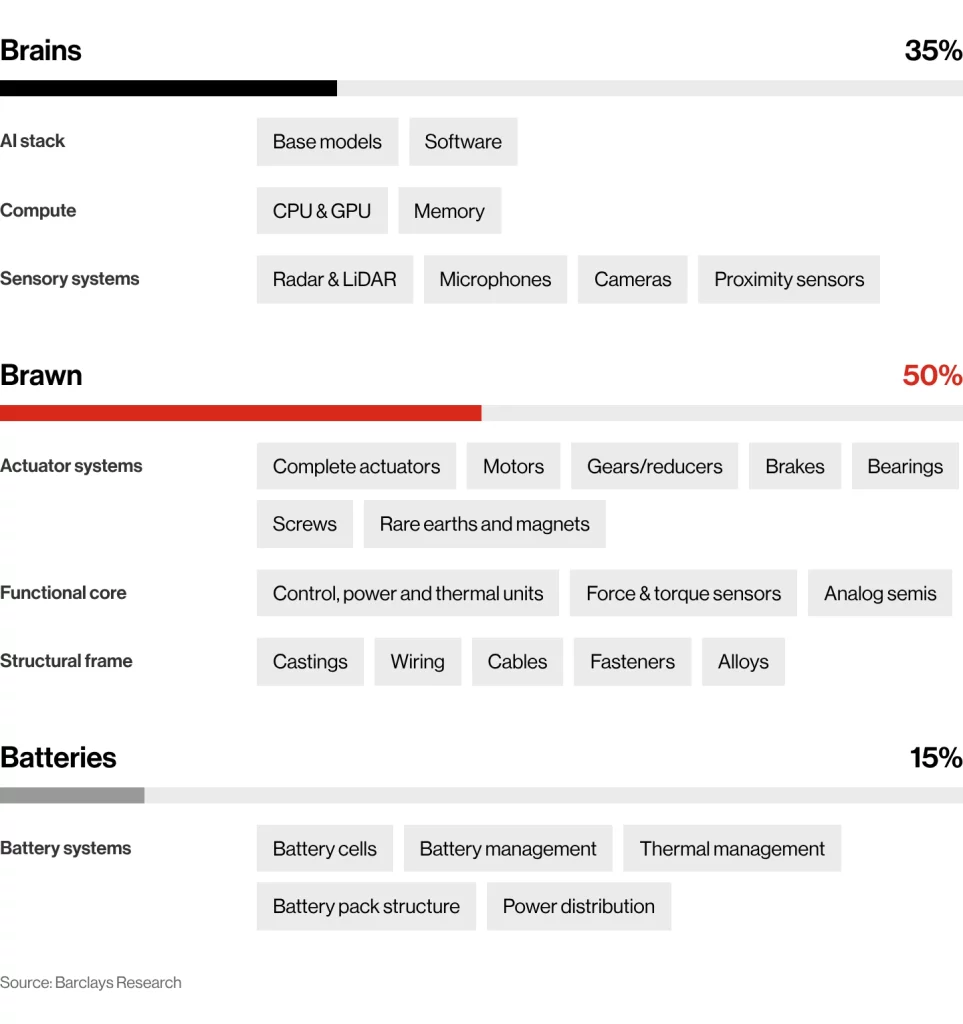
Brain-related components, including processors, cameras, and control systems, are concentrated in fewer units and benefit from semiconductor economies of scale. Brawn components comprise numerous high-precision actuators, gears, bearings, and other electromechanical parts that require tight manufacturing tolerances and complex assembly processes. Batteries represent the smallest share of costs, as humanoids require significantly less energy storage capacity than electric vehicles, limiting both battery size and overall expense.
The Brains
Humanoid robots are increasingly powered by advanced AI models spanning vision, motion, and language, enabling them to perceive, reason, plan, and interact effectively with their surroundings. These capabilities are critical for operating in unstructured environments, where conditions are dynamic, unpredictable, and difficult to address with traditional automation or pre-programmed workflows.
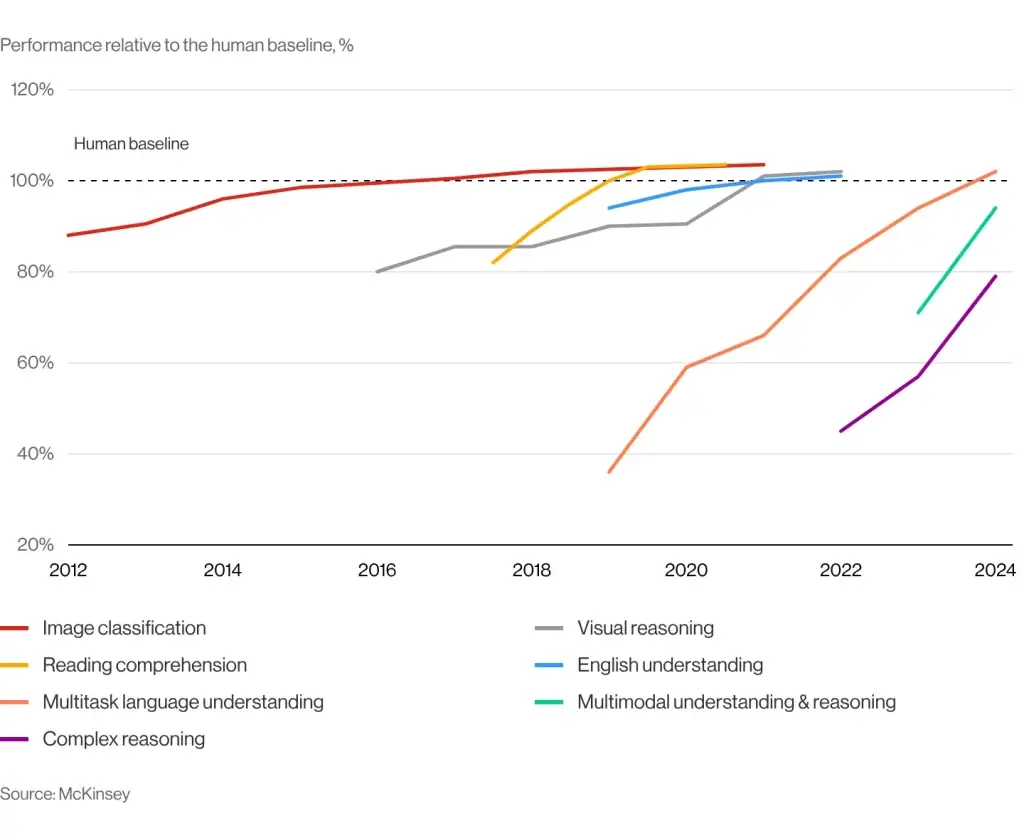
Recent breakthroughs in perception, reasoning, and hierarchical control have significantly enhanced humanoids’ ability to understand context, adapt to changing situations, and execute tasks intelligently in real-world settings. As shown in Figure 5, AI performance across several capabilities relevant to humanoid deployment has steadily improved, reaching, and in some cases surpassing, human-level capability. Image classification exceeded human performance in 2016, followed by visual reasoning in 2021. More recently, multitask language understanding surpassed human benchmarks in 2024, allowing a single AI model to perform a wide range of tasks without relying on multiple specialised systems.
Despite this rapid progress, several key capabilities remain below human performance levels. Multimodal understanding and reasoning, which allows humanoids to integrate visual, auditory, and tactile inputs into a cohesive understanding of their environment, continues to lag behind human capability. Similarly, complex reasoning, including the ability to process multi-step logic, connect abstract concepts, and draw insights across different contexts, remains an area of active development.
That said, the gap is narrowing rapidly. Ongoing advances in foundation models, multimodal AI, and reasoning architectures are expected to further enhance humanoids’ autonomy and adaptability, accelerating their deployment across both industrial and consumer applications.
Figure 5: Gains in AI perception and reasoning have paved the way for real world humanoid deployment
The Brawn
However, even the most advanced AI requires a mechanism to translate decisions into physical movement, and that role is performed by actuators. Often described as the robot’s “muscles,” actuators convert electrical energy into motion, enabling humanoids to walk, lift objects, bend their limbs, and interact with their environment.
A typical actuator consists of an electric motor, gears that regulate speed and force, bearings for smooth movement, and sensors that provide feedback to improve control. Designing actuators that are simultaneously powerful, lightweight, precise, and cost-effective remains one of the most significant engineering challenges in humanoid robotics.
Similar to how the human brain sends signals to muscles to generate movement, an AI model sends commands to actuators, which then execute the desired action. Actuators can take various forms, including rotary actuators used in joints such as the shoulders and hips, and linear actuators used in the legs and lifting mechanisms. Regardless of their design, their primary function is to enable controlled, coordinated, and human-like movement.
Despite recent advances, today’s humanoid robots still have far fewer degrees of freedom than the human body, limiting their agility, dexterity, and overall usefulness. Human motion is made possible by a highly sophisticated system of compliant joints, flexible spines, and elastic tendons that work together to produce smooth and efficient movement. By comparison, humanoids remain largely rigid structures composed of metal components, motors, and relatively simplified joints.
Advances in actuator technology are helping to narrow this gap. Improvements in precision, response time, and torque control are enabling movements that appear increasingly natural and human-like. Better torque control allows robots to regulate force more accurately, resulting in smoother, more stable motion and greater dexterity when handling delicate objects or performing complex tasks.
At the same time, modern actuator systems continuously adjust movements to maintain balance and stability, reducing the risk of falls or unintended actions. As a result, enhanced actuators are improving both the functionality and safety of humanoids, supporting their adoption in industrial settings and environments shared with humans.
The Batteries
Humanoid robots are powered primarily by lithium-ion batteries, which offer a balance of energy density, weight, and cost. These battery systems rely on critical minerals such as lithium, cobalt, nickel, and manganese to deliver the power required for sustained operation. Much of this energy is consumed by actuator systems, as every movement requires force to overcome gravity, inertia, and balance constraints.
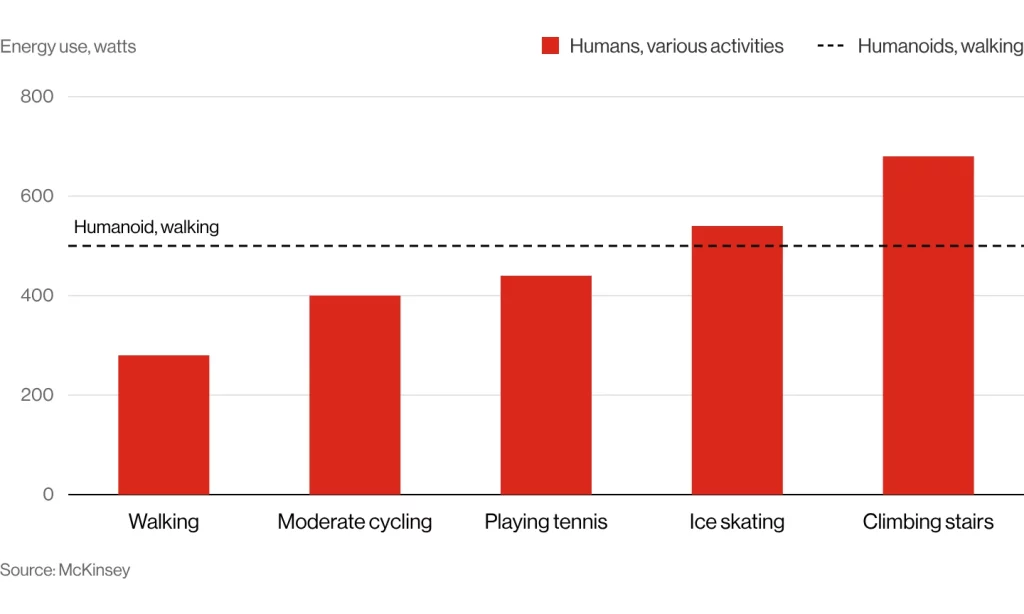
Even standing upright is computationally and energetically demanding, requiring continuous micro-adjustments to maintain stability. As a result, current humanoids typically achieve operating times of only four to five hours, with intensive tasks reducing battery life even further.
Despite rapid advances in AI and robotics, humanoids remain significantly less energy-efficient than humans. For example,. In practice, the average person only reaches a comparable level of energy expenditure during more physically demanding activities.
Figure 6 – Humanoids’ energy footprint
Advances in battery technology are helping to address these limitations. Over the past decade, lithium-ion battery costs have fallen by nearly eightfold, falling to approximately US$100 per kilowatt-hour in 2024. At the same time, the rapid expansion of global energy storage capacity has improved manufacturing scale and supply-chain efficiency. Together, these developments are making battery-powered humanoids increasingly economically viable.
From a cost perspective, we estimate that “brawn” components account for approximately 50% of a humanoid’s bill of materials, followed by “brains” at 35% and batteries at 15%. While these figures are indicative, they highlight the disproportionate importance of mechanical systems within the humanoid value chain.
While industry attention is often centred on the “brains” and “batteries” that power humanoid robots, the greatest engineering challenge lies in the “brawn”, particularly in replicating the dexterity, mobility, and autonomy of the human body. Barclays’ analysis indicates that brawn accounts for approximately 50% of total humanoid production costs, compared with 35% for brains and 15% for batteries.
Actuators and other mechanical systems will constitute the most critical component of the humanoid value chain. Their performance and scalability will ultimately determine whether humanoid robots can be produced economically at scale and deployed safely and effectively across industrial and household environments.
The first beneficiaries: AI compute and Physical AI models
The near-term investment case is strongest in AI infrastructure. Humanoid developers need three compute layers: simulation compute to generate synthetic training data, foundation-model training to create perception-to-action intelligence, and edge inference to run control locally on the robot. This builds on the same AI infrastructure cycle that already supports large language models, but adds new Physical AI workloads.
The key insight is that compute monetisation can occur before robot monetisation. Even if large-scale humanoid deployment doesn’t begin till the mid-2030s, developers still require simulation, model training and edge compute investment during the development phase. This makes AI infrastructure the lower-risk way to gain early exposure to humanoids compared with buying pre-profit robot OEMs.
The geopolitics of manufacturing: China’s structural advantages
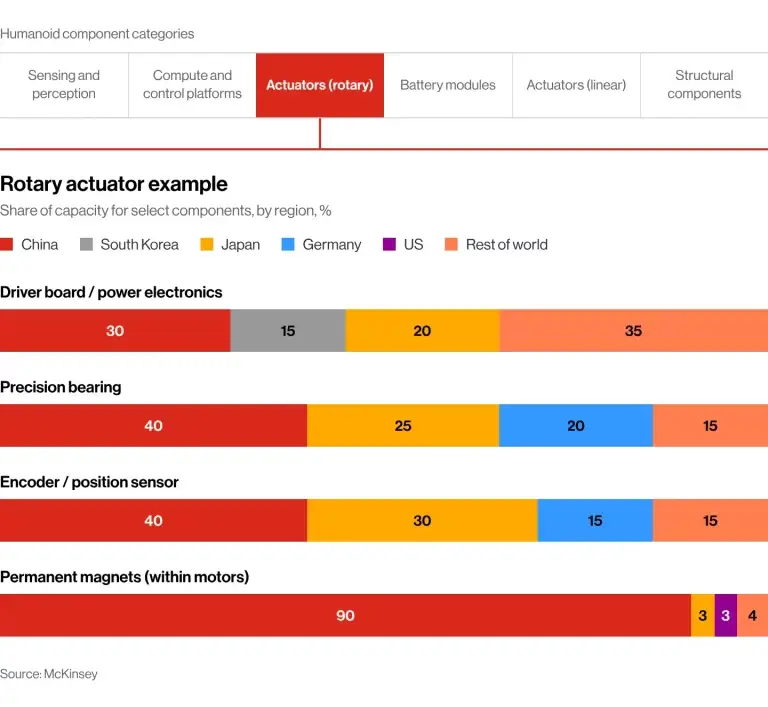
China is exceptionally well positioned in the Physical AI race and already represents approximately 75% of both the humanoid robotics and autonomous vehicle (AV) markets. Its advantage stems from a deep and highly integrated manufacturing ecosystem.
Physical AI development relies on extensive networks of suppliers, component manufacturers and production facilities, areas where China has spent decades building scale and expertise. Today, these strengths are reinforced by strong government support, rapidly advancing AI capabilities and significant economies of scale.
China’s innovation strategy is also reflected in its intellectual property landscape. Chinese patents tend to focus on robot kinematics, the mechanical and structural foundations that enable movement and functionality. In contrast, US patents are more heavily concentrated on control systems and autonomy, which determine how robots perceive their environment, make decisions and execute actions.
This progress was showcased at the second World Humanoid Robot Games, held in Beijing in August this year. During the event, a Chinese humanoid robot set a new 100-metre sprint record of 8.86 seconds, outperforming both its robotic competitors and the fastest human time ever recorded. By comparison, the robot far surpassed the men’s 100-metre world record which stands at 9.58 seconds, set by Jamaican sprinter Usain Bolt in 2009.
Such achievements highlight the rapid advancement of China’s robotics capabilities and underscore the potential impact of humanoid robotics on the country’s industrial transformation. As robots become faster, more capable and increasingly autonomous, they are expected to play a pivotal role in enhancing productivity, addressing labour shortages and strengthening China’s position as a global manufacturing leader.
China appears to be leading in deployment volumes and manufacturing experimentation. However, many current platforms are still focused on demonstrations, research, entertainment or narrow pilots rather than heavy-duty industrial-grade deployment.
Geopolitics is likely to shape the industry. Robotics may become strategically sensitive because humanoids combine AI, cameras, sensors, mobility, factories and physical infrastructure. The likely outcome is not one global supply chain but parallel regional ecosystems: China-led hardware and domestic deployment on one side, and US, European, and Japanese ecosystems for industrial, defence-sensitive and critical-infrastructure applications on the other.
Figure 7 – China has a significant share of capacity for robotics components
Hardware bottlenecks: actuators, reducers and rare earths
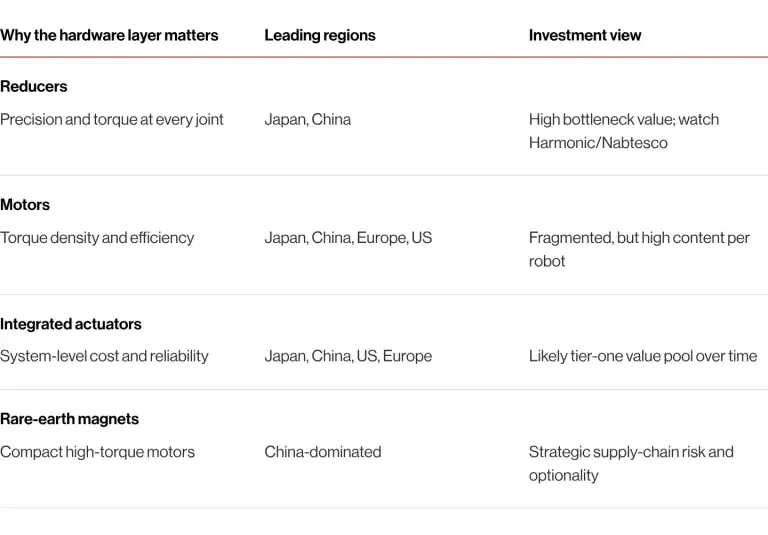
Actuation is the most important hardware bottleneck. Humanoid movement requires a large number of compact, precise, durable and power-efficient joints. Reducers convert high-speed motor output into usable torque, directly affecting accuracy, smoothness and reliability. High-precision reducers are difficult to manufacture, require tight tolerances and have long qualification cycles, which creates high barriers to entry and meaningful supplier concentration.
Japan is the current leader in high-end reducers. Harmonic Drive Systems dominates harmonic reducers, which are well suited for compact, high-precision joints such as arms, wrists and hands. Nabtesco leads in cycloidal reducers, which are well suited for larger load-bearing joints such as hips, legs and shoulders.
China is moving fast, particularly in cost-competitive reducers, motors, batteries and integrated robot manufacturing. Given China’s role in rare-earth extraction, refining and magnet manufacturing, the upstream materials layer may remain a strategic dependency even if Western robot production localises.
The most attractive hardware exposure may ultimately be integrated actuator modules rather than individual parts. As volumes rise, robot OEMs will want fewer SKUs, simpler assembly, better reliability and standardised modules. Suppliers able to integrate motor, reducer, bearings, sensors, control electronics and thermal management should capture more of the actuator value stack.
Figure 8 – Humanoid robot hardware and where it’s produced
Sensors, semiconductors and connectivity, the overlooked “content per robot”
One of the most underappreciated aspects of the humanoid opportunity is the semiconductor and connectivity content embedded within each robot. Humanoids represent an incremental growth opportunity rather than a standalone investment case. Many of the underlying technologies are already benefiting from long-term trends such as industrial automation, electrification and edge AI. Humanoid adoption would add another layer of demand on top of these existing markets.
Connectivity is another attractive area of the value chain. Barclays estimates that humanoids could contain $400-$1,200 of sensor and connector content per unit, significantly higher than that of a typical autonomous mobile robot. As robots become more capable, the need for power distribution, motion control and high-speed data communication increases, creating opportunities across the broader industrial technology ecosystem.
Risks, valuation discipline and investment recommendation
The biggest risk is timing. Humanoid adoption could take longer than current enthusiasm implies. The autonomous-vehicle cycle is a useful reminder: impressive demos do not automatically translate into broad commercial deployment. Safety, reliability, edge-case handling, regulation and customer ROI can slow adoption for years.
The second risk is economics. Hardware cost is only one part of the investment case. What matters is cost per productive hour, which depends on uptime, maintenance, utilisation, task capability, battery runtime and software reliability. A cheap robot with poor uptime is not economically useful. Conversely, an expensive robot that operates reliably for long shifts can be attractive if it performs valuable work.
The third risk is supply-chain concentration. Precision reducers, rare-earth magnets, batteries and some actuator components have concentrated supply chains. China’s dominance in rare-earth processing and magnets creates geopolitical and sourcing risk. Japan’s leadership in reducers creates bottleneck risk if humanoid volumes rise quickly.
The fourth risk is valuation. Humanoids are an exciting long-term theme, but many direct plays are pre-revenue, private, speculative or priced for distant optionality. Investors should prefer companies where humanoids are upside optionality on top of already strong existing drivers such as AI compute, semiconductors, industrial automation or electrification.
The future of the humanoid revolution
The future of humanoids will be determined by the supply chain. Today’s ecosystem is still in the earliest stages of industrialisation, leaving a vast runway for capacity expansion. Yet every layer we map reinforces the same conclusion: when humanoids become infrastructure, execution matters more than innovation. The winners will not simply build the smartest robots; they will build robots that can survive shortages, tariffs, conflicts and shifting alliances. Supply chain risk is not part of the narrative. It is the narrative.
As value migrates away from the robot and into the network of dependencies beneath it, the first wave of financial winners is likely to emerge from the suppliers of intelligence, compute and high-precision components. This shift is already being reinforced by national investments such as Singapore’s Home Team Humanoid Robotics Centre (H2RC), which is developing embodied AI humanoids for public safety applications, underscoring how governments and institutions are accelerating the deployment of robots into mission-critical infrastructure.
In the humanoid era, the most valuable company may not be the one with the robot on stage, but the one powering every robot behind it.
Disclaimer
This material is for the use of the recipient in accordance with the restrictions and/or limitations implemented by any applicable laws and regulations only. It is intended only for the recipient and may not be published, circulated, reproduced or distributed in whole or in part to any other person without the Bank’s prior written consent. Unless otherwise indicated, the information is made available for informational purposes only, without considering the recipient’s financial situation, investment objectives, risk tolerance, financial situation, or any other particular needs and should not be treated as legal or taxation advice.
The information is not and should not be construed as an offer or a solicitation to deal in any investment product or to enter into any legal relations. Any investment decision made based on the information provided is the sole responsibility of the client. The Bank disclaims any liability for any losses or damages resulting from the use of this information. The Bank assumes no responsibility for the way in which the client may choose to use or apply this information, or for any investment decision or transaction that the client might undertake as a consequence. It is the client’s own responsibility to ensure that this product is suitable for him or her and the client must make his or her own decision concerning this product. The client may also wish to obtain advice from other sources before making any decision.
Past performance is not indicative of future results. Any forecast on the economy, stock market, bond market and economic trends of the markets are not necessarily indicative of the future or likely performance of the product. Any investment involves risks, including the total loss of the invested capital.
For queries arising from, or in connection with this material, please contact the person who sent you this material. This advertisement has not been reviewed by the Monetary Authority of Singapore.