/ Monthly Market Update - October 2026
Hyperscalers & The AI Landscape
This article provides an analytical deep dive into hyperscalers - the massive technology companies anchoring the global digital economy and the ongoing Artificial Intelligence (AI) revolution as we know it.
Table of Contents
Insights
As corporate capital expenditure (capex) reaches historic heights, market participants are growing increasingly more anxious regarding monetization horizons and valuation multiples.
In this article, we examine what hyperscalers are, the foundational drivers of current market nervousness, an evaluation of whether an AI infrastructure bubble is poised to burst, and a strategic framework for navigating investments within this interconnected ecosystem.
What are Hyperscalers?
Hyperscalers are massive companies providing cloud computing, data storage, and large-scale processing infrastructure capable of dynamically scaling up or down to meet massive enterprise demands.
They do not merely operate data centers; they architect global networks of specialized computer hardware, proprietary fiber optic lines, custom silicon, and power management grids.
The baseline threshold to be considered a modern hyperscaler involves operating hundreds of thousands of servers across global data center zones which are then backed by tens of billions of dollars in annual infrastructure deployment.
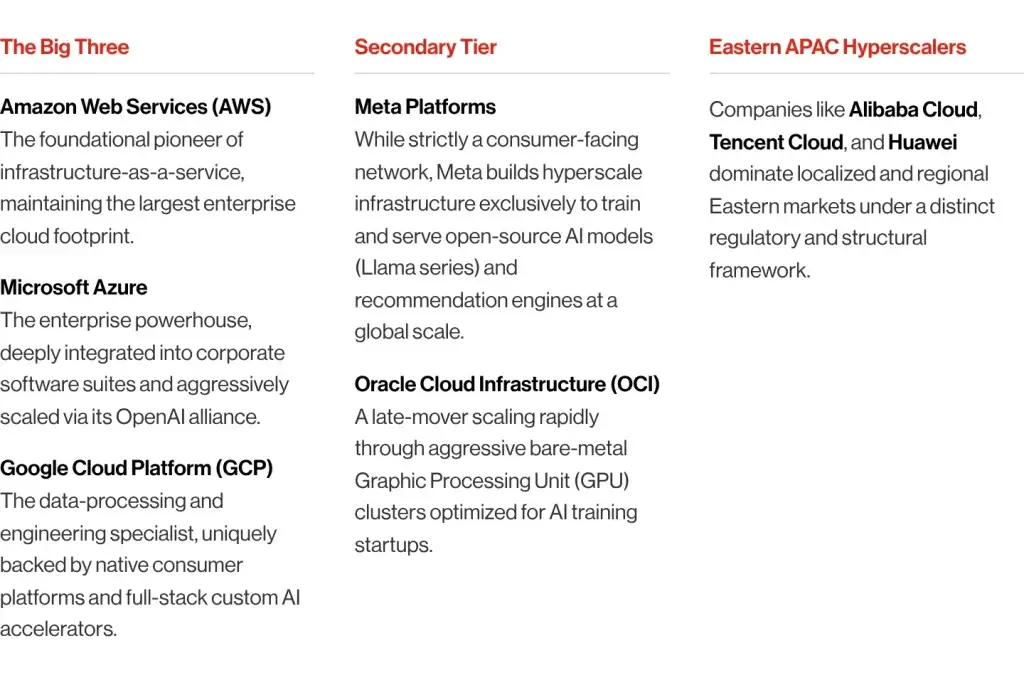
The hyperscaler tier is highly exclusive, structurally protected by astronomical capital barriers to entry. Globally, the marketplace is bifurcated into Western leaders and Eastern fast-followers:
The Source of Market Anxiety
The present concern is not that AI is imaginary. Demand for AI computing, cloud services and data processing is real. The concern is that the industry is committing capital faster than the economic returns can be verified.
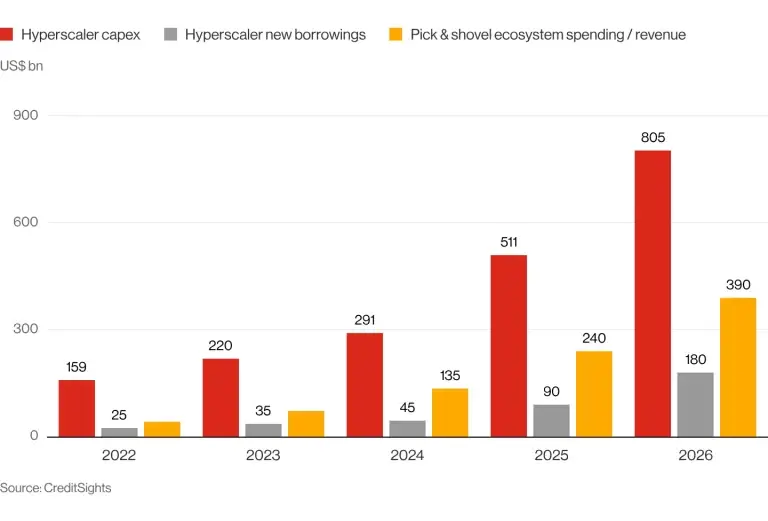
TMT Finance estimates that the four largest US hyperscalers – Amazon, Microsoft, Google and Meta – could spend approximately US$720 billion to US$745 billion in 2026, versus roughly US$410 billion in 2025. Including the fifth, Oracle, would take the broader figure beyond US$800 billion.
This creates a familiar investment paradox. AI may transform the economy while still producing disappointing returns for investors who pay excessive prices or back the wrong part of the value chain.
Railways, telecommunications and the internet all created enormous economic value ultimately, but many early infrastructure investors suffered because capacity expanded too quickly, competition reduced returns, or valuations already discounted unrealistic growth.
Key reasons why the market is nervous
- The ROI Mismatch: Wall Street is seeing multi-billion dollar expenditures hit cash flow statements immediately, while enterprise AI software revenue streams are scaling linearly rather than exponentially. This creates an immediate margin compression risk.
- The Power and Energy Crisis: Data centers are stretching municipal and national power grids to their absolute limits. The reliance on legacy grids has forced hyperscalers to pursue multi-billion dollar nuclear, geothermal, and green-energy purchase agreements, compounding capital intensity.
- Rapid Hardware Obsolescence: An AI cluster built today utilizing previous-generation hardware can face a 50% drop in cost-efficiency within 18 months due to rapid leaps in computing performance. Hyperscalers run the risk of holding massive, unamortized, obsolete infrastructure assets potentially in a short period of time.
- Revenue visibility is weaker than infrastructure visibility.
Are we in a bubble?
The answer depends on which part of the market is being considered…
In the case that this is a bubble
The current cycle does indeed display several bubble characteristics:
- Capital spending is rising much faster than proven end-customer monetisation.
- Competitive fear is encouraging companies to invest because they cannot afford to fall behind, rather than because every project meets a disciplined return threshold.
- Valuations in parts of the supply chain assume several years of uninterrupted spending and high margins.
- Debt, leases, private credit and project-finance structures are increasingly being used to fund data-centre expansion.
- Investors are extrapolating shortages in GPUs, power equipment and data-centre capacity as though those shortages will be permanent.
In February 2026, CreditSights estimated that capital expenditure by the five largest hyperscalers could reach approximately US$750 billion in 2026, a 67% year-on-year increase. Its analysis suggested capex could reach approximately 86% of sales for Oracle, 54% for Meta Platforms, 47% for Microsoft, 46% for Alphabet and 25% for Amazon.
Figure 1 — Hyperscaler AI spending: infrastructure cycle vs ecosystem growth
The case that it is not a bubble as we know it
There are important differences between what we’re seeing now as compared to the late-1990s internet cycle.
In the dot-com era, companies burned cash whilst promising future earnings, without actual profits. Modern hyperscalers are different. They are highly cash-generative, extraordinarily profitable enterprises. Their core cloud, advertising, and e-commerce segments generate hundreds of billions in free cash flow to subsidize these AI bets.
AI is being integrated into search, advertising, software development, cybersecurity, customer service and enterprise productivity rather than existing only as a speculative concept.
The infrastructure also has alternative uses. A data centre designed for AI can often support inference, analytics, conventional cloud computing or future models, although conversion may not be costless.
Moreover, the major platforms can monetise AI indirectly through advertising efficiency, customer retention and higher cloud consumption, not only through stand-alone AI subscriptions.
Therefore, instead of an implosion, the market is set to experience an ‘AI Capex Rationalization Phase.’ Should enterprise AI adoption stall, hyperscalers will simply taper their next-stage infrastructure builds and return to it at a more appropriate timeline in the future.
If it is a bubble, will it burst?
A nuanced assessment dictates that we should not see a fatal crash, but more of a cyclical normalization, which is highly probable.
Unlike the dot-com era where companies burned cash without profits, modern hyperscalers are highly cash-generative, extraordinarily profitable enterprises. Their core cloud, advertising, and e-commerce segments generate hundreds of billions in free cash flow to subsidize these AI bets.
Therefore, instead of an implosion, the market is set to experience an ‘AI Capex Rationalization Phase.’ Should enterprise AI adoption stall, hyperscalers will simply taper their next-stage infrastructure builds.
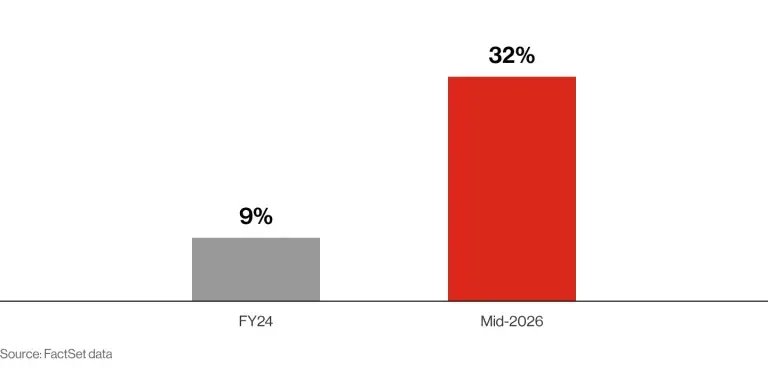
Figure 2 — Incremental annual debt as % of capex
Risks, valuation discipline and investment recommendation
Early signs of normalisation are already visible, although not yet in aggregate capital expenditure. The adjustment is instead appearing first in cash-flow compression, greater reliance on external financing and increasing investor resistance to ever-higher spending without demonstrable returns.
The stock prices may experience a sharp 20-30% valuation reset, but their balance sheets will remain fundamentally strong. The largest hyperscalers could survive a spending disappointment because they have profitable core businesses.
Their shares may nevertheless underperform if depreciation rises, free cash flow falls or investors conclude that AI expenditure is defensive rather than value-creating.
The decisive question is no longer, “Will AI usage grow?” It almost certainly will.
The more relevant question is, “Will incremental AI revenue provide a return that’s attractive given the hundreds of billions of dollars that’s being invested today?”
Pivoting to the ecosystem
Our primary strategy is to reduce direct overweight positions in hyperscalers and pivot more into the physical infrastructure and downstream application layers of their ecosystem.
Hyperscalers are currently engaged in a classic prisoner’s dilemma. If Microsoft stops buying GPUs, Google wins an edge; if Google stops, AWS takes market share and so on. Consequently, they are structurally forced to overspend, transferring massive wealth to their ecosystem providers up front.
By shifting capital away from the capital-expending hyperscalers and toward the peripheral providers (such as power grid infrastructure, thermal liquid cooling specialists, and proprietary data holders), investors protect themselves against an AI software bubble while fully capitalizing on the inescapable infrastructure buildout.
In conclusion, the most likely outcome is neither an uninterrupted boom nor a complete collapse. It is a period of increasingly selective returns.
The financially strongest hyperscalers should remain strategically dominant, while weaker projects and highly valued suppliers face greater downside if spending growth moderates.
Investors should therefore maintain measured exposure to the leading platforms, avoid paying any price for growth, and diversify toward scarce infrastructure providers with strong balance sheets, multiple customers and demonstrable pricing power.
The safest framing is to invest in AI as a long-duration industrial transformation, not as a one-way momentum trade.
Disclaimer
This material is for the use of the recipient in accordance with the restrictions and/or limitations implemented by any applicable laws and regulations only. It is intended only for the recipient and may not be published, circulated, reproduced or distributed in whole or in part to any other person without the Bank’s prior written consent. Unless otherwise indicated, the information is made available for informational purposes only, without considering the recipient’s financial situation, investment objectives, risk tolerance, financial situation, or any other particular needs and should not be treated as legal or taxation advice.
The information is not and should not be construed as an offer or a solicitation to deal in any investment product or to enter into any legal relations. Any investment decision made based on the information provided is the sole responsibility of the client. The Bank disclaims any liability for any losses or damages resulting from the use of this information. The Bank assumes no responsibility for the way in which the client may choose to use or apply this information, or for any investment decision or transaction that the client might undertake as a consequence. It is the client’s own responsibility to ensure that this product is suitable for him or her and the client must make his or her own decision concerning this product. The client may also wish to obtain advice from other sources before making any decision.
Past performance is not indicative of future results. Any forecast on the economy, stock market, bond market and economic trends of the markets are not necessarily indicative of the future or likely performance of the product. Any investment involves risks, including the total loss of the invested capital.
For queries arising from, or in connection with this material, please contact the person who sent you this material. This advertisement has not been reviewed by the Monetary Authority of Singapore.