/ Monthly Market Update - September 2026
The Battery Renaissance
From data centres and electric vehicles to renewable grids and autonomous machines, the next era of electrification is bringing energy storage out of the background and into the centre of modern infrastructure.
Table of Contents
Insights
From the First Battery to the Battery Renaissance
In 1800, Italian physicist Alessandro Volta invented the world’s first true battery, known as the voltaic pile. For much of the 19th century, batteries provided one of the earliest sources of electricity before electric generators and power grids became the dominant way of producing and distributing energy. Yet despite their importance, batteries eventually became a supporting technology, overshadowed by ever larger power stations and vast electrical networks.
Their prospects appeared so limited that in 1883, Thomas Edison famously dismissed storage batteries as little more than a novelty. For more than a century, that perception largely endured.
Today, the world has circled back. We are witnessing what might be described as a Battery Renaissance.
The reason is simple. Electricity has become the lifeblood of the modern economy. Artificial intelligence, data centres, electric vehicles, robotics and the broader electrification of industries is driving a surge in power demand. At the same time, solar and wind generation are being deployed at record pace, rapidly transforming how electricity is produced.
According to the International Energy Agency, renewable energy is expected to account for more than 45% of global electricity generation by 2030, with solar and wind representing a rapidly growing share of the global power mix. Yet unlike conventional power plants, renewable energy is generated when the sun shines and the wind blows, not necessarily when electricity is needed most.
This creates one of the defining challenges of the next decade: bridging the gap between when power is generated and when it is consumed.
The story of energy storage today is about how the world’s energy system is being redesigned. As electricity demand accelerates and the energy transition gathers pace, batteries are returning to centre stage, not as a supporting actor, but as one of the essential building blocks of the future economy.
A World Hungry for Electricity
We are entering what the International Energy Agency has called the “Age of Electricity.” Between 2026 and 2030, global electricity demand is expected to grow at a much faster pace than in the previous decade. As economies decarbonize, electricity is increasingly becoming the preferred source of energy for transportation, industry, buildings and digital infrastructure. At the same time, renewable sources such as solar and wind are being deployed at record pace to meet this growing demand.
Yet a fundamental challenge is emerging. Electricity generation is becoming cleaner, but also more variable. Solar power peaks during daylight hours without clouds and wind generation depends on weather conditions, while electricity demand follows the rhythms of daily life and economic activity. As renewable energy occupies a larger share of the energy mix, matching supply with demand is becoming one of the defining challenges of modern power systems.
The stakes are also higher than ever before. Data centres, communication networks, transportation systems and advanced manufacturing all depend on a continuous and reliable power supply. In an increasingly digital and interconnected economy, electricity is no longer merely a utility. It has become a strategic resource underpinning economic growth, competitiveness and national resilience.
Recent geopolitical tensions and volatility in global oil and gas markets have further reinforced the need for energy security, accelerating global investment in decarbonized means of electrification, grid modernization and flexible power solutions.
Against this backdrop, the resurgence of energy storage is no accident. It is driven by necessity. As the world’s appetite for electricity continues to grow, batteries have become the critical bridge between energy supply and demand.
Three Forces Driving Demand for Energy Storage
Three powerful structural trends are accelerating demand for energy storage: the rise of artificial intelligence, the representation of AI in the physical world, and the growing need for grid resilience as renewable energy adoption increases. Together, they are creating a world that requires not only more electricity, but smarter ways to store and deliver it.
1. Artificial Intelligence
The AI revolution is not just creating demand for more computing power. It is creating demand for more electrical power. As technology companies invest hundreds of billions of dollars into data centres, electricity has become a critical input alongside semiconductors and software.
Unlike traditional facilities, AI data centres place enormous and highly variable demands on the grid. Power consumption can surge within seconds as workloads shift across thousands of processors. Batteries are increasingly being deployed to smooth these fluctuations, provide backup power and improve reliability. In many respects, batteries are becoming an essential part of the AI infrastructure stack, helping ensure that the digital economy remains online, stable and secure.
2. Digital AI to Physical AI
Until recently, artificial intelligence lived largely in the digital realm, processing information inside data centres and cloud networks. The next chapter is different. AI is stepping into factories, warehouses, hospitals and homes through robots and autonomous machines capable of interacting with the physical world. Every one of them requires a source of mobile, reliable power.
As AI becomes increasingly embedded in physical infrastructure, from automated factories and smart warehouses to autonomous transport systems, demand for high-performance batteries is set to expand alongside it. In many ways, batteries are becoming the unseen foundation of this transformation, enabling intelligence not just to think, but to move, adapt and operate in the real world.
The relationship between AI and batteries is also becoming increasingly symbiotic. AI is creating new demand for energy storage through data centres and autonomous machines, while advances in AI are helping to improve battery design, performance optimization and energy management. Together, they are reinforcing one another, accelerating the transition towards a more automated, electrified and intelligent economy.
3. Renewable Energy and Grid Resilience
The third force is the transformation of the energy system itself. Solar and wind power are growing rapidly around the world, but renewable energy does not always arrive when it is needed. The sun may be shining at noon, while electricity demand peaks after sunset. Wind generation can be abundant one day and scarce the next.
For most of the past century, electricity systems were built around large power plants that could adjust output to meet demand. Renewable energy changes that equation. Increasingly, power systems must adapt to the availability of renewable generation rather than the other way around.
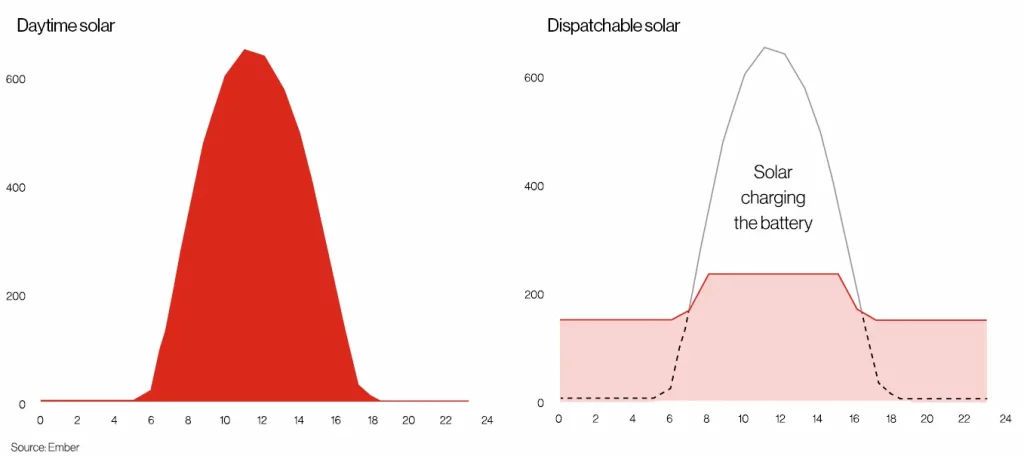
This is where energy storage becomes indispensable. By capturing excess electricity during periods of abundant renewable generation and releasing it when demand rises, batteries effectively shift energy across time. They transform intermittent energy into dispatchable energy. The simple equation increasingly favoured by utilities and developers is:
Renewables + Storage = Reliable Power
Figure 1– Example of transforming daytime solar energy to dispatchable predictable energy
Reliability is becoming more valuable as economies become more digital and interconnected. From extreme weather events to power outages and grid congestion, recent years have highlighted the importance of resilient energy infrastructure.
As electricity systems become more complex, batteries evolve into the modern equivalent of a reservoir or dam. Just as water reservoirs store excess rainfall and release it when needed, battery energy storage systems store surplus electricity and dispatch it during periods of scarcity.
For investors, this may be the most important shift of all. As renewable penetration continues to increase, energy storage is moving from a helpful addition to a foundational component of the global power infrastructure.
Why Energy Storage is making sense now
A major reason is economics. Battery costs have fallen dramatically over the past decade, transforming storage from a technical possibility into an increasingly commercial solution. According to Ember research, the total installation cost of battery storage projects has been dropping since 2017 to present, in just 2024 to 2025, global battery prices fell by 31%.
Technology improvements have also strengthened the investment case. Modern battery systems are becoming more efficient, longer lasting and capable of storing larger amounts of electricity within a smaller footprint. Ember notes that today’s storage systems can hold roughly twice as much electricity in a standard container compared to only a few years ago.
Safety, a historical concern for some investors and policymakers, has improved significantly as battery technology has evolved. Much of the industry’s growth has been driven by lithium iron phosphate (LFP) batteries, which are generally regarded as more thermally stable and better suited for stationary energy storage applications.
At the same time, manufacturers, regulators and grid operators have introduced more rigorous safety standards, testing procedures and monitoring systems, helping make modern battery storage projects safer and more reliable than earlier generations.
This is why energy storage is rapidly moving from the sidelines to the centre of global energy transition.
A Global Race for Energy Storage
While the drivers of energy storage are global, the path each region is taking reflects its own economic priorities, energy resources, natural conditions and policy choices. What is emerging is not a single market, but a global race to secure the technologies and infrastructure needed for an increasingly electrified world.
United States: Powering the AI Boom
In the United States, the rise of battery storage is closely tied to surging electricity demand from artificial intelligence, data centres and electrification. Battery installations have grown rapidly in recent years, with storage becoming one of the largest sources of new power capacity additions. Large-scale battery projects are increasingly being deployed alongside solar farms and near major demand centres, helping to relieve grid congestion and support peak electricity demand.
The attraction of batteries is their speed. New storage facilities can be developed much faster than conventional power plants, allowing utilities and developers to respond more quickly to growing electricity needs. As AI infrastructure expands across the country, batteries are increasingly viewed as essential grid infrastructure rather than simply a renewable-energy accessory.
In many ways, America’s battery story is becoming an extension of its AI story.
Europe: Balancing Energy Transition
Across Europe, the focus is somewhat different. The region has moved aggressively to expand renewable energy, but recent years have exposed the challenges of managing a power system increasingly dependent on variable generation.
Periods of strong solar and wind production can push electricity prices sharply lower, while calm or cloudy conditions can lead to sudden shortages and price spikes. As older coal plants are retired and the region seeks to reduce reliance on imported fossil fuels, maintaining grid stability has become a growing concern. Battery storage is emerging as one of the key tools to address these challenges.
Case in point is Finca La Cuesta, an agricultural operation in Spain. It completed the second phase of an energy self-consumption project in July, combining 150 kW of solar generation with a 125 kW/257 kWh Battery Energy Storage System (BESS). The solution was designed to reduce the farm’s electricity costs by 75% to 80%.
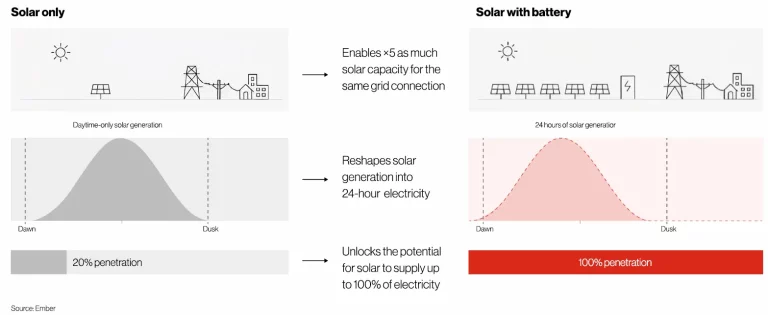
Figure 2 provides a graphical illustration of how batteries can bring solar penetration from 20 per cent to 100 per cent.
Figure 2 – Comparison of Solar only to Solar with battery
Asia: Where Demand Growth Meets Electrification
Asia sits at the centre of the global energy transition. The region is home to some of the world’s fastest-growing economies, largest urban populations and most energy-intensive industrial sectors. For example, annual EV sales in Thailand and Vietnam, where the market was virtually nonexistent in 2021, broke 100,000 units in 2025.
Indonesia’s nickel resources, Thailand’s automotive manufacturing capabilities, Vietnam’s electronics ecosystem and Malaysia’s growing battery and semiconductor industries give ASEAN several potential building blocks for a competitive regional value chain.
Recent industry estimates place the Southeast Asian lithium-ion battery market at approximately US$8.32 billion in 2026, with projections suggesting it could reach US$16.27 billion by 2031.
In North Asia, Samsung SDI’s first-ever EV battery order win in Europe with Mercedes this year and two Energy Storage System battery order wins in the US over the past three months has sparked discussions on whether Korean battery players are winning market share.
No discussion of battery storage would be complete without China.
China remains the dominant force across much of the battery supply chain. The country has spent decades building capabilities across battery materials, cell manufacturing, processing and deployment, creating an ecosystem that operates at a scale unmatched by any other region.
Figure 3 – China battery exports (GWh)
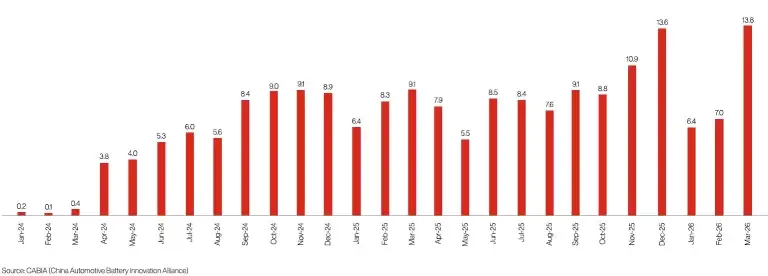
China is also one of the world’s largest adopters of renewable energy and electric vehicles, giving domestic companies a vast market in which to refine technologies and lower costs. The resulting scale has helped drive a dramatic decline in battery prices globally, transforming storage from a niche technology into an increasingly economical infrastructure solution.
Perhaps most importantly, China demonstrates how rapidly energy storage can grow when manufacturing capacity, policy support and end-user demand align. The lessons learned there are increasingly influencing battery markets around the world.
Beyond Lithium: The Next Generation of Storage
While lithium-ion batteries remain the dominant technology today, the next chapter of energy storage is likely to be defined by a broader mix of solutions. Sodium-ion batteries are gaining attention for their lower cost and reliance on more abundant raw materials, making them an attractive option for large-scale energy storage. Solid-state batteries, often viewed as the industry’s “next frontier”, promise higher energy density, improved safety and faster charging, potentially extending the range of electric vehicles and opening new possibilities for robotics and advanced mobility applications.
Beyond these, technologies such as flow batteries, iron-air systems and other long-duration storage solutions are being developed to address applications where conventional lithium batteries may be less effective, particularly for storing electricity over days rather than hours.
Hydrogen too is increasingly being explored as a form of long-duration energy storage. Excess renewable electricity can be used to produce green hydrogen through electrolysis, which can then be stored and converted back into electricity when needed. While less efficient than conventional batteries for short-duration applications, hydrogen offers the potential to store energy for weeks or even months, helping address seasonal imbalances that batteries alone may struggle to solve.
Next-generation nuclear systems, including small modular reactors (SMRs), are increasingly being viewed as complementary to renewable energy and energy storage. Researchers are also exploring radioisotope and nuclear battery technologies capable of providing extremely long-lasting power for specialized applications such as space exploration, remote monitoring systems and defense equipment.
Ultimately, the future of energy storage is likely to mirror the evolution of transportation. Just as cars, trains, aircrafts and ships each serve different purposes, different storage technologies will likely coexist, each optimized for a specific role. Lithium batteries may continue to dominate daily cycling and short-duration storage, hydrogen could emerge for longer-duration applications, while advanced battery chemistries and nuclear technologies address specialized use cases.
The key takeaway here is that the opportunity extends beyond any single battery chemistry. The winners may ultimately be found across a broader ecosystem of technologies that make electricity more flexible, reliable and available whenever it is needed.
Not Without Obstacles
Despite its strong growth prospects, the battery storage industry faces several important challenges. One of the most significant is what happens when batteries reach the end of their useful lives.
As millions of electric vehicles and grid-scale storage systems are deployed globally, concerns are growing around waste management, recycling capacity and the environmental impact of extracting and processing raw materials such as lithium, nickel and cobalt. While battery recycling technologies are advancing, the industry remains in its early stages, and large-scale collection, recovery and reuse systems are still being developed.
A second challenge is improving how batteries are used rather than simply producing more of them. One emerging solution is battery swapping, where depleted batteries are exchanged for fully charged ones in a matter of minutes. Instead of waiting to recharge, users simply replace the battery and continue their journey.
The model has gained traction in parts of Asia, particularly in China, where companies such as NIO have built extensive battery-swapping networks for electric vehicles, while manufacturers of electric scooters and two-wheelers are deploying similar systems across urban markets. By separating battery ownership from vehicle ownership, swapping can lower upfront costs, reduce charging times and potentially extend battery life through centralized management.
The next phase of growth will depend not only on building more batteries, but also on creating a more sustainable and efficient circular economy around them.
Conclusion: Batteries Become Infrastructure
The next decade will not be defined solely by our ability to generate more electricity. It will be defined by how effectively we store, manage and deploy it. In that future, batteries are poised to become what roads were to the industrial era and what the internet was to the digital age: essential infrastructure that enables progress, often operating quietly in the background, but increasingly impossible to do without.
Batteries are becoming the connective tissue of the modern economy, bridging the gap between power generation and consumption, between renewable energy and 24/365 dispatchability, and between intelligence and action. This is the essence of the Battery Renaissance.
For investors, the opportunity extends far beyond battery manufacturers alone. Value is likely to accrue across the broader ecosystem, including grid infrastructure, power management systems, semiconductors, electrical equipment, renewable energy developers and operators of storage assets. As electricity becomes the backbone of economic growth, the companies enabling its reliable delivery may prove just as important as those generating it.
The Battery Renaissance will increasingly shape national competitiveness. Countries and regions that can offer reliable power grids, abundant renewable energy, scalable storage capacity, competitive power purchase agreements and faster grid connections will be best positioned to attract the next wave of investment in AI, advanced manufacturing, automation and digital infrastructure.
The battery’s return is therefore about much more than technology. It is about building the foundations of a more electrified, resilient and intelligent economy. Once dismissed as a niche innovation, energy storage is emerging as one of the defining infrastructure investments of the twenty-first century.
Disclaimer
This material is for the use of the recipient in accordance with the restrictions and/or limitations implemented by any applicable laws and regulations only. It is intended only for the recipient and may not be published, circulated, reproduced or distributed in whole or in part to any other person without the Bank’s prior written consent. Unless otherwise indicated, the information is made available for informational purposes only, without considering the recipient’s financial situation, investment objectives, risk tolerance, financial situation, or any other particular needs and should not be treated as legal or taxation advice.
The information is not and should not be construed as an offer or a solicitation to deal in any investment product or to enter into any legal relations. Any investment decision made based on the information provided is the sole responsibility of the client. The Bank disclaims any liability for any losses or damages resulting from the use of this information. The Bank assumes no responsibility for the way in which the client may choose to use or apply this information, or for any investment decision or transaction that the client might undertake as a consequence. It is the client’s own responsibility to ensure that this product is suitable for him or her and the client must make his or her own decision concerning this product. The client may also wish to obtain advice from other sources before making any decision.
Past performance is not indicative of future results. Any forecast on the economy, stock market, bond market and economic trends of the markets are not necessarily indicative of the future or likely performance of the product. Any investment involves risks, including the total loss of the invested capital.
For queries arising from, or in connection with this material, please contact the person who sent you this material. This advertisement has not been reviewed by the Monetary Authority of Singapore.